The $18 Bosch eBike Motor Cover That Taught Me About Value Over Price
· Elena Markovic
If you've ever bought a part based on price alone, you know where this is going. I've been an office administrator for years, managing our company's purchases—about 80 orders a year. Most of them are boring: toner, chairs, coffee. But a few are critical. Those are the ones that teach you things.
The Morning It Started
We have a 120-person logistics technology company. The campus is big enough that we keep six Bosch e-bikes for the facilities and maintenance teams to get around. Those bikes use a Bosch drive unit that's reliable, but not bulletproof. And one rainy morning, one of them was missing something critical.
Mike from facilities walked into my office holding a cracked plastic shell. 'The cover on the Bosch eBike motor is gone,' he said. 'It blew off somewhere on the loop. The bike is not going to run until we get a new one.'
Motor covers on e-bikes aren't decorative. They keep water, dust, and road grime out of the drive unit. If you lose one, you're looking at possible contamination and corrosion. So I started looking for a replacement right away.
Three or four suppliers had the part in stock. The official Bosch eBike motor cover was $55 plus shipping. There was also an aftermarket one for $18, described as 'compatible with Bosch e-bike drive units.' It was coming from a warehouse in Texas, two-day delivery. On paper, it seemed like a no-brainer.
Our maintenance manual says to use genuine Bosch parts for safety-related components. I know that. But in the moment, a small plastic cover didn't feel safety-related. It was just a shell. I ordered the $18 one and told Mike it would be here Thursday.
The $18 Mistake
When the package arrived, Mike grabbed it and headed out to the shop. Ten minutes later, he was back, shaking his head.
'The screw holes don't line up,' he said. 'And this lip here is different. It's not going to seal.'
I looked at the cover and compared it to the old one. The aftermarket part was close, but the clip was offset by about three millimeters. A tiny difference, but enough to create a gap. Mike suggested we just order the genuine part and eat the cost. But I didn't want to wait another week and explain to my boss why I created a second order for the same item. So I told him to make it work. He forced it into place with a zip tie holding the corner down. It looked okay from a distance.
That was my mistake.
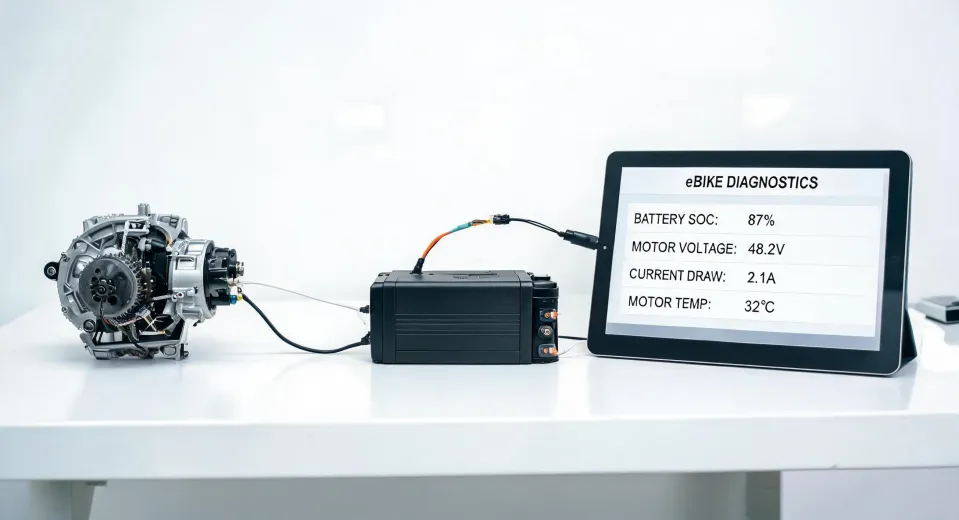
Friday morning, the bike came back with a flashing error on the display and a bad grinding noise from the motor area. We loaded it into a van and took it to a Bosch eBike dealer. The technician popped the cover off and showed us moisture inside the housing. Water had seeped through the gap during a morning ride, and it had started corroding the connector pins. He said we were lucky it hadn't shorted the whole motor.
The fix wasn't just a cover. It involved a new sensor harness, cleaning the contacts, and a complete firmware reflash. The service notes said a Bosch eBike motor update was required to recalibrate the drive unit after the repair. The bill came to $267. After the repair, I bought the genuine cover for $55. Total outlay: $18 + $267 + $55 = $340. Plus four days of a dead bike that people needed.
I'm not 100% sure why the aftermarket part was so close but didn't fit. My best guess is the mold was based on an older version of the housing, or the factory tolerance was just loose. It doesn't matter. The part cost me $285 more than it saved.
What the Engineers Taught Me
The same week, the engineering team asked me to quote some small motors for a prototype. Emily, the lead engineer, needed an mg90s servo motor for a camera positioning fixture, and she was also evaluating a micro stepper motor for a precision linear stage. These were not high-volume parts, but they mattered to the project timeline.
I found one supplier with an incredibly low price for the mg90s servo motor—$2.50 each when we usually paid $5. Another source had a micro stepper motor at a fraction of the usual cost. I presented the quotes to Emily and suggested we buy from the cheaper source to save money.
Emily gave me a look that I now recognize as the 'here we go again' look. 'Did you get the datasheets?' she asked. 'Did you check the torque curves, the current draw, the step accuracy?'
I hadn't. So she pulled up a comparison table from a reputable distributor. The cheap servo had a different stall torque and a slower response time. For the camera fixture, that could cause jitter. The cheap micro stepper motor had a lower step angle tolerance, which mattered because the linear stage needed to hold position without pulsing. A missed step would make the whole system lose calibration, and recalibrating would take hours of lab time.
'You're not buying the part,' she said. 'You're buying the project outcome.'
Then she asked me a question that exposed another gap in my knowledge: 'Do you know how VFD control motor speed?' I said I had a general idea, but honestly, I'd never thought about it beyond knowing that VFDs make motors spin at different speeds. She gave me a short lesson.
'A VFD controls an induction motor by varying the frequency of the supply power,' she said. 'Changing frequency changes the synchronous speed. But you also have to adjust voltage, otherwise the magnetic flux saturates and the motor overheats. Modern drives do this automatically, but only if the drive knows the motor's parameters. A cheap VFD might not have the right settings for your specific motor, or it might lack the low-speed torque needed for your load. If you pick the wrong one, it will trip all the time or burn out the motor.'
I had never thought about that. To me, a VFD was a box that changed speed. To an engineer, it was a control system that needed to match the motor perfectly.
The New Rule
That three-week period changed my buying process. I now have a set of questions I ask for every component, whether it's a foam insert or a servo motor:
- What are the exact specifications and tolerances?
- Does the vendor provide a datasheet or test report?
- Is the part truly compatible, or is it a 'close enough' version?
- What support do we get after the sale?
- What's the cost of failure—downtime, labor, rework, lost confidence?
Per FTC advertising guidance (ftc.gov), performance claims have to be truthful and substantiated. I've started applying that standard to every vendor claim. If a product says 'compatible,' I ask for proof. If a supplier can't show test data or a clear specification, I move on.
The results have been encouraging. We bought the mg90s servo motor from a distributor that sent us a datasheet and a sample to test. The micro stepper motor came from a source that stood behind its specs and answered technical questions before we ordered. And when we needed a VFD, we talked to an application engineer who helped us choose the right model for the motor we were using. That conversation saved us from a very expensive mismatch.
There's a certain satisfaction in having a process that works. No more desperate calls from facilities. No more explaining to finance why an $18 part turned into a $340 invoice. I still care about prices, but I care more about the total cost of owning and using the thing.
More often than not, the lowest quote has cost us more in the long run. Not always—there are deals that work out. But when you skip the due diligence, you're gambling. And the house usually wins.
This was accurate as of Q1 2025. Component prices and firmware updates change fast, so verify current quotes and compatibility before you order.
Take it from someone who paid $340 for a $55 cover: value isn't the same as price. Ask the right questions first. You might save yourself a painful repair bill.