Three Motor Buying Scenarios (And the $4,200 in Mistakes That Taught Me the Difference)
· Elena Markovic
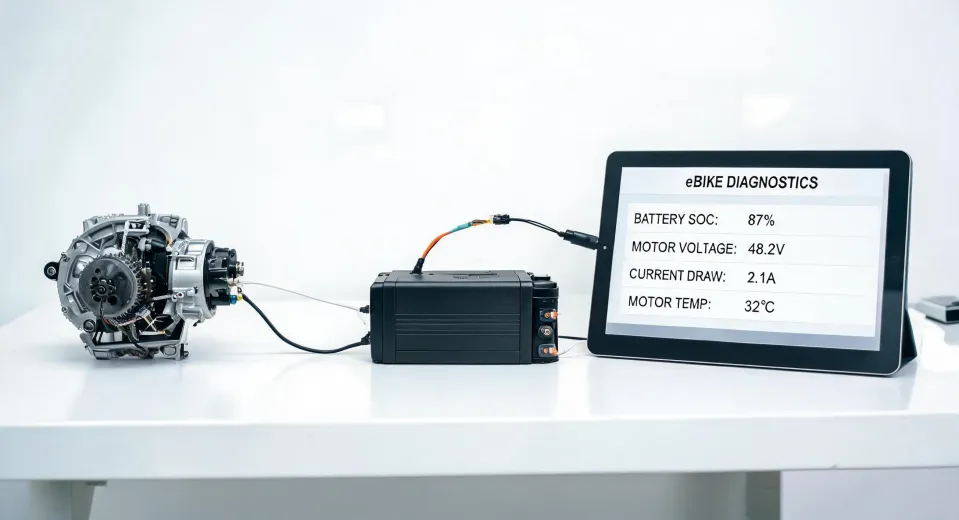
I've been handling motor and drive orders for about twelve years now—split between e-bike drive systems and industrial motion components. In that time, I've made (and carefully documented) five significant purchasing mistakes totaling roughly $4,200 in wasted budget. Now I keep a checklist on my desk so my team doesn't repeat them.
Here's the thing I wish someone had told me in my first year: when people ask "what motor do I need?" they're actually asking three completely different questions. One person wants to electrify a bike. Another wants to control a small robotic arm. A third wants to automate a conveyor line. They all search the same word. Their needs have almost nothing in common.
Confusing those three groups is exactly how I burned through four grand. So instead of giving you one universal answer—there isn't one—let me help you figure out which scenario you fall into. Once you know that, the right choice becomes almost obvious. The wrong one becomes almost catastrophic.
Quick breakdown of the three scenarios:
- Scenario A: You're an e-bike builder or upgrader looking at Bosch mid drive systems
- Scenario B: You're a hobbyist or small-project builder pricing small servos (MG90S, etc.)
- Scenario C: You're specifying industrial motion—servo motors, stepper motors, drives
Read the one that matches you. Skip the rest. If you're not sure which one you are, the last section walks you through it.
Scenario A: E-Bike Drive Systems — What a Bosch Mid Drive Conversion Kit Actually Costs You
When Bosch makes sense
If you've been searching for the most powerful Bosch e-bike motor, you've probably landed on the Performance Line CX or the Cargo Line. Good instinct. Bosch makes outstanding mid drive systems. The torque delivery is smooth, the sensor integration is genuinely best-in-class, and the reliability is why fleet operators keep coming back.
But here's the part nobody puts in the spec sheet: Bosch doesn't really sell you a motor. They sell a system. Motor unit, battery, display, wiring harness, speed sensor, mounting hardware—all proprietary, all designed to work together. That's a feature if you're buying a complete bike. It's a nightmare if you're trying to retrofit one.
When you should walk away from Bosch
If you're looking at a Bosch mid drive e-bike conversion kit, walk carefully. True OEM Bosch conversion kits are rare. Most of what's sold as "Bosch mid drive conversion" is either (a) a salvage pull from a wrecked bike with unknown history, or (b) a third-party motor being marketed loosely as "Bosch compatible." Neither is what you think you're buying.
I learned this the expensive way. Back in September 2021, I bought a used "Bosch mid drive conversion kit" off a marketplace listing for $1,100. Seller said it was pulled from a 2020 bike with fewer than 500 km. Looked clean in the photos. Sounded plausible.
It arrived. The motor was real Bosch. Everything else was a problem. The battery connector didn't match my frame's mounting pattern. The display cable was from a different generation. The speed sensor was missing entirely. I spent another $340 trying to source compatible parts before giving up and reselling the whole thing at a 40% loss. That single mistake cost me roughly $890.
The lesson: Bosch's mid drive is a closed ecosystem. If you want the Bosch experience, buy a bike that already has Bosch on it. If you want to convert an existing bike, you're shopping in the Bafang / Tongsheng / Cyclone aisle, not the Bosch aisle. Different product category entirely.
I only believed this after ignoring it and eating the loss. They warned me about proprietary connectors. I didn't listen.
So who should actually buy Bosch?
Fleet buyers replacing drive units on existing Bosch-equipped bikes. OEMs building new e-bikes. Anyone who values a closed, warrantied system over modularity. If that's you, Bosch is worth every rupee, dollar, or euro. If you're a DIY converter with a Saturday afternoon and a donor frame—look elsewhere.
Scenario B: Small Servos and the India Pricing Puzzle
What the MG90S actually is (and isn't)
The MG90S servo motor is a metal-gear micro servo. Roughly 2 kg·cm of torque, 4.8–6V operating range, about 13 grams. It's the workhorse of hobby robotics, camera gimbals, and small animatronic builds. Cheap, reliable within its limits, and available everywhere.
What it is not is a torque solution for anything that needs to move more than a few hundred grams continuously. I've burned out three MG90S units because I kept asking them to push a lever that needed more force than they could deliver. That's not a servo failure. That's a sizing failure on my part.
The India pricing question
Searching for servo motor price in India is genuinely confusing because the term "servo motor" covers everything from a ₹120 MG90S clone to a ₹85,000 industrial unit from Delta or Yaskawa. Same words, wildly different products.
For the hobby tier—MG90S, SG90, MG996R—you'll see listings anywhere from ₹95 to ₹450 for what appears to be the same component. The spread usually traces to three things: import duty variance, seller markup, and whether the unit is a genuine TowerPro or a clone. I'm not 100% sure which clones are trustworthy and which aren't, so take this with a grain of salt: the best signal is seller review volume, not seller claims about "original quality."
For industrial servos in India—the ones with real torque, real feedback, real price tags—expect quotes to vary by 30–50% between brands for comparable specs. In 2023 I compared a European-brand servo against an Indian-made equivalent for a small conveyor project. The Indian unit came in at roughly half the price with equivalent torque and IP rating. The difference showed up mostly in support response time, not in the hardware itself.
Context matters more than brand here
This advice holds for small and mid-size automation projects where uptime expectations are reasonable. If you're running a 24/7 line with contractual SLAs, the calculus flips. Support response time starts to matter more than purchase price, and the premium brand earns its premium.
I can only speak to domestic Indian procurement. If you're importing or dealing with multi-country logistics, there are probably duty and lead-time factors I'm not aware of.
Scenario C: Stepper vs Servo — The Industrial Question
What's a stepper motor, in plain terms
A stepper motor moves in discrete increments—steps. Give it a pulse, it rotates by a fixed angle. Give it 200 pulses, it rotates 360 degrees (on a standard 1.8° motor). No encoder, no feedback loop, no tuning. It just counts.
That simplicity is why steppers dominate 3D printers, CNC routers, and a huge share of light industrial positioning tasks. They're cheap, they hold position when stopped (holding torque), and they don't need a controller that understands closed-loop math.
When you actually need a servo instead
Steppers lose steps when overloaded. They also lose torque as speed increases—dramatically. Servo motors don't, because they close the loop with an encoder and correct in real time.
So the question isn't "which is better." It's "does my application tolerate occasional position drift?"
If you're moving material on a conveyor, sorting packages, or running a glue dispenser—probably yes, a stepper is fine. If you're doing high-dynamic pick-and-place, high-speed spindle positioning, or anything where a lost step means a scrapped part—you need a servo.
Three variables drive the decision: load variability, speed profile, and consequence of position error. In that order.
The buried cost nobody budgets for
Servo systems cost more than the motor. You need a compatible drive, encoder wiring, and someone who knows how to tune the loop. I've seen projects where the motor was 30% of the total system cost and the drive plus engineering was the other 70%. Steppers, by contrast, are closer to plug-and-play.
Never expected this when I started: many "we need a servo" conversations end with a stepper once the true system cost is on the table. The performance requirement was real. The budget for it wasn't.
How to Figure Out Which Scenario You're In
Answer three questions in order. Stop at the first one that's a clear "yes."
- Are you pushing a bicycle wheel? You're Scenario A. Focus on complete drive systems, not components. Buy the ecosystem, not the motor.
- Are you moving something under 5 kg with a small controller (Arduino, Raspberry Pi, RC receiver)? You're Scenario B. Size your servo with 50% headroom on torque, and don't overpay for a name on a micro servo.
- Are you automating a machine that runs more than a few hours a day? You're Scenario C. Match the motion technology to your error tolerance, not to a spec sheet reputation.
If you're stuck between B and C, the deciding factor is duty cycle. Hobby projects run for minutes. Industrial systems run for hours. The longer your runtime, the more you should be paying for closed-loop control and real support.
And if you're stuck between A and anything else—you're probably not actually in Scenario A. E-bike drive systems are a distinct world with distinct parts. If you find yourself comparing a Bosch mid drive against a servo motor, you've already answered your own question.
One last thing, and I mean this sincerely: measure your load before you buy anything. Every "stepper vs servo" or "which mid drive" argument gets simpler once you know the actual torque required. I've made the mistake of guessing twice. Both times it cost more than the measurement would have.
Pricing references in this article are for general guidance only and vary significantly by vendor, region, and time of purchase. Verify current rates and specifications before ordering.