I Wasted About $9,700 on Wrong Motor Parts — Here's the 6-Check Ordering Checklist I Use Now
· Elena Markovic
-
The Six Checks I Run Before Every Order
-
1. Photograph the label before you trust the description
-
2. Confirm what kind of motor you're actually replacing
-
3. Check the servo motor pinout on the drawing that came with the part
-
4. Measure the mounting dimensions — a size is three numbers
-
5. Match the drive or controller generation, not just the brand
-
6. Write the order down before you click submit
-
1. Photograph the label before you trust the description
-
Where the Checklist Still Breaks
I run a small supply shop that handles replacement parts for electric-drive and linear-motion systems. Some weeks it's a fleet customer waiting on a display for an e-bike with a Bosch mid-drive; other weeks it's a machine builder who needs a brushless DC servo motor and a set of linear bearings on the same order. I've handled orders like those for six years, and I've personally made (and documented) 14 significant mistakes, totaling roughly $9,700 in wasted budget. Maybe it's $10,500; I'd need to check the spreadsheet. Either way, that's why our team has a checklist, and it's not decoration.
Use this when you're replacing one component in a system that already exists. If you're designing a new machine from scratch, this isn't the right tool. For the much more common job—ordering a motor or bearing so a line can run again—these six checks take about 15 minutes, and they've saved me thousands.
The Six Checks I Run Before Every Order
1. Photograph the label before you trust the description
“It's a Bosch mid-drive” is the start of a conversation, not a part number. Bosch has shipped several generations of e-bike drive units, and they don't all share the same display mounts, battery connections, or replacement parts. In my first year (2019), I sent a customer a replacement display for an e-bike with a Bosch mid-drive. He'd said “the standard one,” and I let it go. The display had the wrong mount. Return shipping cost $85, and I still remember the look on his face when I called to say I'd messed up.
Now the rule is: no label photo, no order. If the label is hidden, I ask for photos of every connector too, with a ruler next to the part if there's any doubt about size. I don't ask for those photos to be difficult. I ask because I do not want to own a mistake that a photograph would have prevented.
2. Confirm what kind of motor you're actually replacing
The first question I ask about any motor is whether it's a plain brushless DC motor or a brushless DC servo motor. They look related, and the power leads are similar, but a servo motor includes a feedback device and expects to be driven by a servo drive that understands it. Without that feedback, a motor may spin fine—until the machine needs to hold position.
Everything I'd read about replacement motors said that a matching voltage and frame size was enough. In practice, that advice misses the feedback. I once ordered a replacement, and the motor sat on our bench for two weeks because nobody checked whether its feedback signal matched the drive. The motor was fine. The order was wrong.
This is where the Yamaha vs Bosch e-bike motor question usually shows up in my shop. Customers ask which one is better, and my answer is not what they expect: for a replacement decision, the comparison that matters is between the drive unit in the frame and the parts catalog. A mid-drive motor is integrated with a controller, display, and battery. Choosing a brand because of a forum thread doesn't tell you which generation you have or whether its parts are still available.
3. Check the servo motor pinout on the drawing that came with the part
This is the step I skipped in March 2024. I ordered a brushless DC servo motor to replace a failed unit. The new motor had the same feedback connector—same shell, same pin count—as the old one, so I told our technician the pinout would be identical. It wasn't. The drive threw an encoder fault within seconds of power-up. A $110 adapter cable fixed the wiring, but the machine stayed down for three extra days while we sorted it out.
Now I pull the servo motor pinout diagram from the specific motor drawing, not from the file I saved the last time. Manufacturers, and sometimes different series from the same manufacturer, reuse the same connector shell with different internal pin assignments. Honestly, I've never fully understood why they do that. My best guess is that it saves tooling costs, but it makes life harder for everyone on this side of the cable.
4. Measure the mounting dimensions — a size is three numbers
When a customer asks, “What size is an LM8LUU linear bearing?” I get what they mean. The part number tells you it's an 8 mm-bore bushing. The L after the 8 tells you it's the long version, usually 15 mm outside diameter and around 45 mm total length in the version most suppliers stock. But the number that matters is how the bearing fits the housing in front of you. More wrong bearing orders are caused by matching only the shaft diameter than by any other mistake I can name.
Last fall I ordered 60 LM8UU bearings because the customer said “8 mm.” He was right about the shaft. The bearing blocks were machined for the long version, and the standard-length bearings rattled around in the pockets. 60 pieces, around $230—maybe $260, I don't have the invoice in front of me—went straight into the spare-parts bin.
So measure the bore, the outside diameter, and the length. If you're working from a part number alone, decode it, then verify it with a ruler. Put another way: the “8” in LM8LUU refers to the shaft, not the housing. Those are two different problems.
5. Match the drive or controller generation, not just the brand
A motor is one half of a system. The controller on the other side expects a particular feedback type, a particular current limit, and often a particular software version. I've seen a resolver-equipped servo motor connected to a drive that only accepted digital encoders. That wasn't a wiring problem; it was an ordering problem.
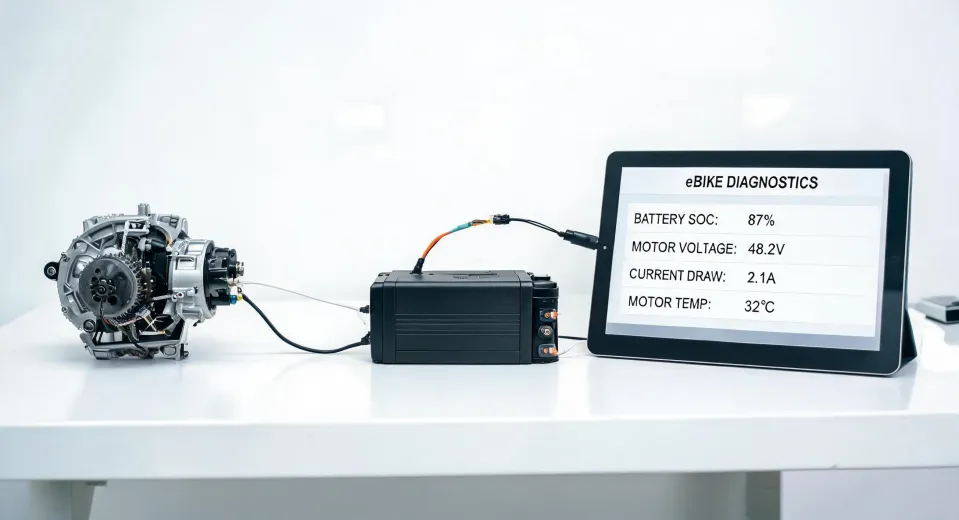
The same logic applies to e-bikes. An e-bike with a Bosch mid-drive is not a loose motor. The drive unit, display, battery, and controller are designed to work as a system. If you order a component from the wrong generation, the system may not even power on. Newer components can also require registration or activation with diagnostic software, which means the cheapest part online is not the cheapest path if it can't be paired.
6. Write the order down before you click submit
If you can't explain in one sentence why you're ordering that exact part number, stop. In Q1 2024, after the third wrong quote in a month, I built a one-page order sheet for the team. It has the machine serial number, the old part label, the replacement part number, the source, and a photo link. It takes five minutes to fill out, and it has caught more errors than any other step.
This isn't bureaucracy. A purchase order is a promise that the part will fit. The photo or drawing is the proof. If the supplier lists three variations and you can't point to the reason you picked one, you haven't done the check yet.
Where the Checklist Still Breaks
The checklist fails when people treat it as optional for “quick” orders. There is no quick order. The 15-minute check is what prevents the two-week return.
Since we put this process in place, we've caught 47 potential problem orders in the past 18 months. Most were boring catches: a photo that didn't match the part number, a bearing length that was wrong, a connector that looked identical but wasn't. That's exactly what a checklist is for.
One last thing: if the component is still under warranty, don't order anything until you've checked the warranty route. This matters especially with newer e-bike drive systems, where an authorized workshop may need to handle diagnostics. The best parts order is the one you don't have to place. I learned that after roughly $9,700 of my own mistakes, so you don't have to.