72 Hours to Demo Day: What a Rush Bosch E-Bike Repair Taught Me About Small Clients and Smaller Fixes
· Elena Markovic
I was one step from the parking lot when the phone rang — 4:52 on a Tuesday in November 2024. Most days I let it go to voicemail at that hour. Something made me pick up, and I’m still not sure whether to be grateful or annoyed about that.
By way of introduction: I coordinate rush orders and technical service calls at a driveline-and-motion-control distributor. We sell the unglamorous stuff that keeps factories and workshops moving — servo motors, VFDs, belts, linear bearings, and Bosch e-bike drive systems for the small fleet and light-EV folks in our region. I’ve taken calls while customers stood next to a dead production line, and I’ve learned to ask the same first question every time: how many hours do you really have?
“Seventy-two,” said Maya, the founder of the little e-bike startup in the unit behind ours. “Demos Friday at 9 a.m. — twelve of our e-cargo bikes in front of the buying team at a national retailer. If we blow this, we don’t get a second date. And right now, one of our Bosch motors is completely dead, two motor covers are cracked, and another bike keeps throwing an overheating warning. The service hotline told me to budget for two replacement motors and a January repair slot.”
That last sentence is the part that got my attention.
The expensive answer
Here’s something worth knowing about Bosch e-bike motor prices: a complete replacement drive unit, as of late 2024, was landing around $1,100–$1,400 through authorized dealers before installation. (Verify current pricing — that number moves.) Two motors would have been roughly three times the total that this customer had spent with us in the past eight months. Their “big” orders were $800 and their first order was $240. A big-shop sales rep would have called that a waste of time.
But I have a soft spot for small test orders. When Maya started renting the workshop, the vendors who took her $200 order seriously are the ones she trusted later. And honestly, this wasn’t about being nice. It was about the fact that a rush order stops being small the moment it’s urgent.
I stood there in the parking lot and did the math. The easy route was to quote two new motors, collect a big rush-order fee, and let a service center do the diagnosis next year. The right route — the one my gut kept coming back to — was a forty-minute drive and a look at the actual bikes. Every expensive repair I’ve regretted started with a remote diagnosis and a confident quote.
So I said the phrase I’d learned to say after nine years of rush jobs: “I can’t promise anything until I look at the bikes. But I’ll be there at seven tomorrow morning with tools and parts. Don’t order new motors tonight.”
A dead motor that wasn’t dead
Wednesday, 7 a.m. Maya’s lead engineer, Jake, had already pulled the “dead” motor off bike number four and strapped it to the workbench. It wouldn’t power up on the display, wouldn’t move, wouldn’t do anything. Jake had even swapped in a known-good battery. “It’s toast,” he said.
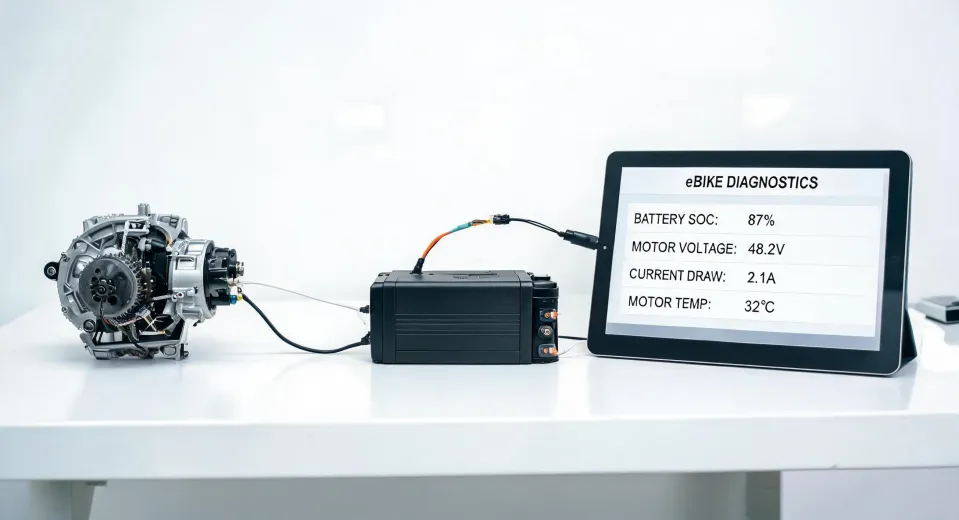
Here’s where it gets interesting. We plugged the drive unit into the diagnostic laptop — Bosch’s software still saw the unit, which is not what a dead motor does. What it reported was a sensor error on the torque signal. Ten minutes of cable tracing later, we found the real problem: a pinched harness under the bottom bracket. When the bike went down hard, the bracket had pinched and shorted the torque-sensor wires. Bosch’s safety logic treats a missing torque signal as a fault and cuts motor power completely. The motor was fine. The wiring harness wasn’t.
Total cost to fix: a new harness, some cable management, half an hour. Not $1,300.
Now, before you tell me that’s obvious — I know. But I have watched otherwise sensible repair quotes skip straight to the most expensive possible part. The hardest discipline in rush work is stopping yourself from replacing things before you’ve looked at the connections.
Next, the two cracked motor covers. And this is one of the cases where the cover matters more than people think. The Bosch e-bike motor cover isn’t just a cosmetic shroud; it keeps the connectors, wiring, and venting protected on the drive unit. Cracks let moisture and road grit in, and a rental fleet bike absolutely will see rain. Bosch lists the outer cover as a service part, but availability was… let me put it this way: the online parts portal showed a two-week backorder for one side of the country. I called a dealer we work with on the west coast and paid $68 in next-day freight to get two cover kits here by Thursday afternoon.
While I was at it, I checked the torque-arm and mounting bolts on the other bikes. Loose mounting bolts cause more “motor failures” than motor failures do, honestly. But that’s a story for another day.
Overheating was brake drag, not motor failure
The third complaint was the one that could have put a new motor on our invoice. “Overheating warning on bike seven,” Maya said. The display had shown a thermal warning that morning, and the motor felt hot — genuinely hot — after a 15-minute test ride.
The disc brake system was the last thing I checked, which is embarrassing because it should have been the first. A disc brake system needs two things to run free: a rotor that’s true, and a caliper that’s aligned to it. Bike seven had taken a hit to the rear wheel, and the rotor had a visible wobble. The caliper was pushing one pad against the rotor almost constantly. You can’t always feel that drag as a rider, but the motor can. A constant brake drag forces the motor to pull current just to keep the bike rolling; by the time Jake got back from his test ride, the drive unit had logged a long run at elevated current and the thermal sensor did exactly what it was designed to do.
The fix wasn’t a motor. It was a new rotor, a caliper alignment, and a bleed of the rear brake. Total parts cost: about $42. The motor didn’t need to be replaced. It needed to stop being asked to drag half the braking system around the block.
I’ll be honest: I put that overheating code in the back of my head as a likely motor replacement when I walked in that morning. The conventional wisdom is that Bosch e-bike motors are sealed, complicated units, and when one complains about heat, you swap it. In practice, at least in this shop, external problems cause the complaint far more often than the drive unit does. The motor is usually the victim, not the criminal.
One bearing size question
Thursday morning, while we waited for the covers to land, Jake asked me to look at something in the back workshop. Their load-test rig — a small carriage sliding on two 8 mm rails, driven by a 24 V brushless motor — had burned up a brushless DC motor driver two days earlier, and the replacement driver was throwing an overcurrent fault on start. “And while you’re here,” Jake said, “what size is the LM8LUU linear bearing in this spec? Because the drawing tells me one thing and the person who assembled it tells me another.”
Quick answer, because it comes up more than you would think: the number after the LM is the bore in millimetres. So an LM8LUU fits an 8 mm shaft. The sleeve outside diameter is 15 mm, and the L means long — the sleeve is about 35 mm overall, compared with the standard LM8UU at roughly 24 mm. They are not interchangeable in every carriage.
And that, as it turned out, was the whole problem. Somewhere in assembly, a standard LM8UU had been dropped into one end of the carriage where the design called for the longer LM8LUU. It looked right and slid fine by hand, but under load, the shorter bearing let the carriage rock, which made it bind on the shaft at the exact point where the carriage reversed direction. Every pass pulled more current through the brushless DC motor driver until — well, MOSFETs don’t like that. The first driver had literally smoked. The brand-new replacement driver kept tripping its overcurrent protection because the bearing was still binding.
Two LM8LUU bearings cost us $16. Installing them took ten minutes. The motor driver never faulted again.
That one still hurts in a good way: a $220 driver was killed by an $8 bearing mismatch, and a second $220 driver was about to be blamed for it. We changed the bearing instead, and the whole test bench came back to life. It’s the same lesson as the Bosch motor — expensive parts fail loudly, but cheap parts fail quietly and get blamed on the expensive ones.
Friday morning
The cover kits arrived at 3:47 Thursday afternoon, because freight companies love a good cliffhanger. Jake and I had the first bike reassembled by 5:30, and the second by six. A last short test ride in the dark confirmed what the log told us — the motor on bike seven ran cooler with a free-spinning brake than it had in months.
Friday, 9 a.m., Maya’s bikes rolled into the retailer’s demo space. I didn’t go, honestly, because I had a stack of invoices and the kind of paperwork that follows any rush job. But I texted her at noon. Thirteen words back: “Rode all twelve. Someone already asked about a fleet order.”
What I actually learned
Everything about that job had screamed “big fix.” A Bosch e-bike motor price of more than a thousand dollars. A replacement brushless DC motor driver in a hurry. Two backordered covers. None of it was the actual story.
The actual story was a pinched wire, a warped rotor, and a linear bearing that was eleven millimetres too short — about $300 in parts and a lot of diagnostic honesty.
And the other lesson is about the customer. If we had looked at Maya’s lifetime order value and passed on the emergency, she would have been stuck with a $2,600 quote for motors she didn’t need. Today, eight months later, she’s a different kind of customer, and I don’t mean small. Small doesn’t mean unimportant. It just means there’s less margin for them to waste on the wrong fix.
A rush order teaches you the same thing over and over: check the cheap stuff first, take the small customer seriously, and never let a price tag convince you that the expensive part is the broken one.