Bosch eBike Motor Service: A 6-Step Checklist When the Clock Is Running
· Elena Markovic
-
When This Checklist Applies
-
Step 1: Let the System Talk Before You Do Anything
-
Step 2: Check What Is Not the Motor
-
Step 3: Run a Diagnostic Readout and Update the Firmware First
-
Step 4: Choose the Certain Route for Sealed Drive Unit Repairs
-
Step 5: Match the Replacement Motor Before You Order It
-
Step 6: Test Ride and Re-Check Fault Memory After Installation
-
Common Mistakes That Cost You a Day
- Quick Answers to Related Motor Questions
-
Bottom Line
I coordinate service at an e-bike workshop that works almost exclusively on Bosch eBike Systems. Since 2021, I've processed somewhere north of 200 drive-unit diagnostics, replacements, and "the bike made a noise and I need it fixed before Saturday morning" jobs. Most of those jobs did not end with a new motor. The ones that did usually took longer than necessary because someone skipped a step.
This is the checklist we use when the calendar is the real boss: a demo fleet has to leave, a customer is flying out for a tour, or a rental operator has booked bikes for the weekend. It won't replace a Bosch-certified workshop. It will help you avoid wasting a day on the wrong diagnosis.
When This Checklist Applies
Use this if you have a Bosch e-bike motor that is doing one of these things:
- Showing a warning or error code on the display
- Cutting out under load
- Making noise that seems to come from the motor area
- Needs a service decision inside 48 hours
If your bike is under warranty and you are near a dealer, skip the DIY logic and book the dealer first. The checklist below is for the situation where a dealer visit is already the plan, but you need to arrive with the right information.
Step 1: Let the System Talk Before You Do Anything
The Bosch system stores a lot of information. On bikes with the Smart System, the display or the eBike Flow app will often show an error code before the motor even feels wrong to the rider.
When a customer says "the motor died," the first thing I ask is: What was on the display when it happened? Most people don't look. They just restart the bike. That is understandable, but it deletes useful context.
Write down the code. Note the riding mode, battery percentage, and whether the motor stopped suddenly or faded out. A motor that cuts out at 10% battery is behaving very differently than one that cuts out at 80%.
Step 2: Check What Is Not the Motor
I would estimate that a third of the "motor noise" complaints we get are actually drivetrain noise. The mid-motor sits near the chainring, so sound travels through the frame and fools the rider into pointing at the motor.
Here is the fastest test: turn the motor support off and ride the bike. If the noise is still there with no support, it is not coming from inside the drive unit. Check the chain, cassette, chainring bolts, and—on belt-drive bikes—the belt and sprocket.
This is where the "timing belt noise" question usually comes up. On an e-bike with a carbon belt drive, a dirty or misaligned belt can make a ticking or scraping sound that resonates through the frame. It sounds serious. Often it is just debris packed between the belt and the sprocket, or a belt tension that has drifted out of spec. A dry belt is not a noisy motor. Clean it with water, dry it, and check tension before you start ordering parts.
There is one related thing worth saying clearly: a wet timing belt and an e-bike belt drive are two different worlds. A wet timing belt is a toothed belt that runs inside an engine, lubricated by engine oil. Bosch eBike drive systems do not use a wet timing belt inside the motor. If a customer is searching for "wet timing belt noise," they are usually looking at an automotive problem, not the e-bike.
Step 3: Run a Diagnostic Readout and Update the Firmware First
This is the step most people ignore, and it is the one that saves the most time.
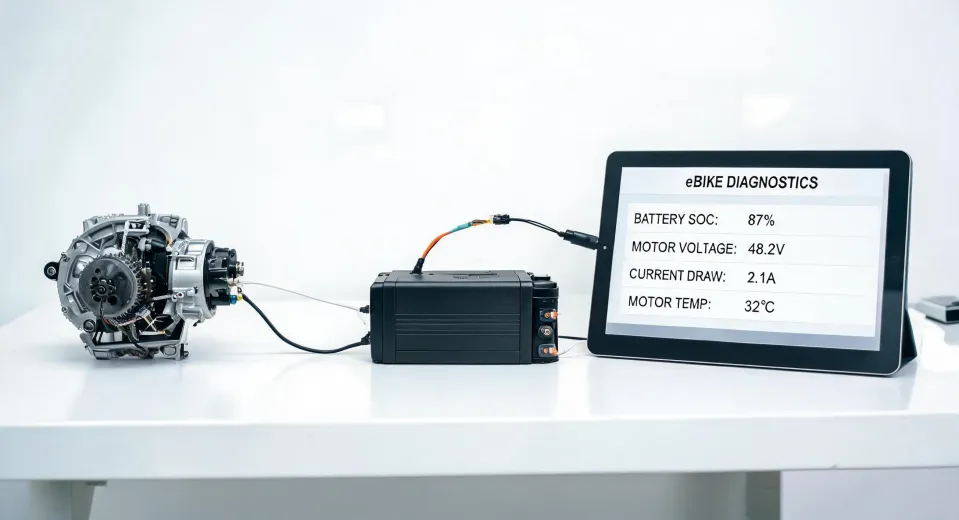
A shop with the Bosch DiagnosticTool can read the drive unit, battery, display, and remote units in a few minutes. If the bike is on the Smart System, there may also be a software update available. Updates fix known communication problems between the motor and the display. I have seen a motor that appeared completely dead come back to life after a BMS update and a fresh system calibration.
In June 2024, a customer brought in a bike with a regular error and a very tight deadline. The first instinct of the mechanic was to pull the motor out and send it for repair. That would have meant a two-week wait. Instead, we ran a diagnostic, updated the system software, and cleared the fault memory. The bike was ready in 45 minutes. The motor was fine. The software state wasn't.
I am not saying updates fix everything. I am saying that skipping the diagnostic step turns a 45-minute job into a 14-day job.
Step 4: Choose the Certain Route for Sealed Drive Unit Repairs
Here is the part of my job that people don't want to hear: a Bosch eBike drive unit is a sealed, high-voltage component. Independent mechanics may be great at bike mechanics, but internal motor repair is a different discipline. The people who are genuinely qualified to open a drive unit are rare, and they have access to specialized parts and firmware that a general shop does not.
If the diagnostic readout points to an internal motor fault, stop short of opening the casing yourself. Use the official Bosch eBike service route. Yes, it can cost more and sometimes involves shipping the drive unit. Yes, it takes longer than a local repair. That is exactly why you build the decision into the schedule instead of hoping for a miracle.
Look, I have mixed feelings about rush service fees. On one hand, they feel like a penalty. On the other hand, after seeing the chaos of failed DIY repairs, I understand why certainty costs more. When a customer needs a motor before a deadline, the cheapest estimate is not the relevant number. The relevant number is whether the bike will be ready on the day it needs to be ready.
Step 5: Match the Replacement Motor Before You Order It
If the unit needs replacing, do not order by model name alone. There are different generations of Bosch drive units, different connector types, and different mounting configurations. The same bike model can use different motors depending on the production year.
Read the part number from the drive unit label. Ask the Bosch dealer to check compatibility. This sounds obvious, but I've lost a day to a motor that was the right model and the wrong system generation.
Now, about the question we hear weekly: which is the most powerful Bosch eBike motor?
In the current Bosch eBike Systems lineup—and it's worth checking bosch-ebike.com for the latest specification because the lineup does change—the Performance Line CX Race is the one that gets called the most powerful. It produces 85 Nm of torque and, in Race mode, pushes peak output up to 600 watts. The standard Performance Line CX also delivers 85 Nm, but the Race version adds a sharper response characteristic aimed at aggressive trail riding.
Here is the part that matters for a service decision: do not buy the most powerful motor just because it is the most powerful. The replacement must match the bike's system generation and intended use. A cargo bike needs the Cargo Line's tuned behavior, not a Race mode. A commuter with a smaller battery doesn't need peak power; it needs efficiency. When you are under time pressure, compatibility beats specs.
Step 6: Test Ride and Re-Check Fault Memory After Installation
The job is not done when the new motor is bolted in. I have seen bikes come back within a day because the installer skipped the final test.
After installing a Bosch mid-drive motor, run through the system again. Check that the motor is detected by the display. Re-calibrate the speed sensor if required. Then ride the bike under real load—including a hill if you can find one—and switch through the support modes.
Finally, do another diagnostic readout. The motor has to sit quietly in the fault memory once everything is clear. A ten-minute test ride is not a luxury. It is the difference between a job done and a job returned.
Common Mistakes That Cost You a Day
- Skipping the diagnostic readout: You cannot see a software issue with your eyes.
- Assuming all motor noise is motor failure: Check the chain, cassette, and belt first.
- Ordering parts before checking the system generation: The model name is not enough.
- Opening a sealed drive unit at a general shop: This usually ends in warranty loss and a longer delay.
- Ignoring the fault memory after the repair: The bike will tell you if the installation is incomplete.
Quick Answers to Related Motor Questions
What stepper motor has to do with this
If your search brought you here from a different direction, you may be asking: "what stepper motor is, and why would I need one?" A stepper motor is a brushless motor that rotates in precise, fixed increments rather than spinning continuously. It is used in industrial motion control—things like printers, packaging machines, and positioning systems—where exact movement matters more than raw speed. Stepper motors are not used as Bosch eBike mid-drive motors. An e-bike drive unit needs high torque at varying speeds and continuous rotation, which is a different motor job entirely.
If you are choosing a motor for an industrial application rather than an e-bike, the question is not "what stepper motor is the most powerful?" It is whether the application needs position accuracy (stepper tends to fit well), high dynamic speed control (servo is usually better), or sustained high torque in a compact package (a geared motor may be the answer).
Timing belt noise and wet timing belt: one phrase, two very different repairs
Because these keywords keep appearing together, let me separate them cleanly:
- Timing belt noise on a car: This can be a worn belt, a tensioner issue, or a misaligned pulley. It should be diagnosed quickly because a broken timing belt can damage the engine.
- Wet timing belt: This is a timing belt that runs inside the engine oil. Oil contamination or age can make the belt degrade from the inside, which is why wet timing belts often have strict replacement intervals. This is a completely different maintenance job from an e-bike belt drive.
- Timing belt noise on an e-bike: Usually not a timing belt at all. It is a dry carbon drive belt, and the noise is usually caused by debris, wear, or tension. Do not oil it. Just clean it, check it, and set the tension to the manufacturer's spec.
Bottom Line
Emergency Bosch eBike motor service is less about guessing and more about process. Let the diagnostic system speak. Separate real motor faults from drivetrain noise. Update the software before pulling the unit apart. Choose the certified service route when certainty matters. And match the replacement motor to the bike, not to the spec sheet.
If you do those things, you might still not get a same-day fix. But you will know exactly what you are waiting for and why. In my experience, that is worth more than a promise that turns out to be wrong.