Stepper vs. Brushless DC Motors & Bosch vs. Yamaha E-Bike Drives: A 6-Step Procurement Checklist
· Elena Markovic
-
Step 1 — Lock down the duty cycle in writing
-
Step 2: Calculate total cost of ownership, not unit price
- Step 3: Know the motor types — stepper, brushless DC, and e-bike drive units
-
Step 4: Audit the system around the motor
-
Step 5: Read the warranty fine print — twice
-
Step 6: Verify claims with certifications and reference calls
-
Common mistakes to avoid
-
Final thought
Six years ago, I signed a $4,200 purchase order for stepper motors that looked like a smart deal — about 18% cheaper than the alternative. Three months later, those motors were failing on the production line. The rework cost $1,200 and the line sat idle for a week.
That failure changed how I buy. I'm a procurement manager at a mid-sized automation company that also assembles e-bikes. I manage roughly $30,000 a year in motor and drive-system spending, and I've tracked every invoice for six years — about $180,000 in total. This checklist is the result. Six steps I refuse to skip when comparing motion control components, whether it's a linear stepper motor for a pick-and-place line or a complete drive unit for our e-bike models.
Step 1 — Lock down the duty cycle in writing
Before I request quotes, I write the duty cycle down. Not a vague 'low speed, light load.' Actual numbers:
- Continuous torque or thrust, and the speed at which it's required
- Peak torque and how long the peak lasts
- Starts and stops per hour
- Standstill current — some motors draw nearly full current just holding position
- Ambient temperature and whether the motor is enclosed
Why does this matter? Because datasheet performance is measured in ideal conditions. The same stepper motor rated for 1.5 Nm on paper might deliver half that once it's warm, enclosed, and running 16 hours a day.
I learned this with a linear stepper motor for a pick-and-place applicator. On paper, the force was fine. But the cycle included a 0.4-second dwell where the motor stayed fully energized without moving. That holding current generated enough heat to de-rate the motor in about two hours. We burned three days troubleshooting the mechanical feed — the real problem was right there in the datasheet's thermal curve. A lesson learned the hard way.
Step 2: Calculate total cost of ownership, not unit price
The lowest quote is only the starting line. I compare vendors with a TCO spreadsheet.
- Unit price
- Controller or driver cost (often quoted separately)
- Energy consumption over five years
- Expected maintenance — brush changes, bearing wear, cleaning
- Expected lifespan and replacement frequency
- Lead time and expedite risk
Example from my records. In 2023, I compared two suppliers for a continuous-duty brushless DC motor. Vendor A quoted $410 each. Vendor B quoted $365. I almost went with B until I totaled the costs. Vendor B's motor required a $95 external controller we didn't need with Vendor A. Vendor B's lead time was six weeks against our three-week deadline, which meant expedite fees on a production-critical order. And Vendor B's motor efficiency was about 4% lower — at 24/7 operation, that added roughly $180 per year per motor in electricity. Four-year TCO: Vendor A was about 14% cheaper. Hidden in fine print.
Step 3: Know the motor types — stepper, brushless DC, and e-bike drive units
An informed customer asks better questions. Let's cover the basics.
What's a stepper motor?
A stepper motor moves in fixed increments — steps. Command 200 steps and the shaft rotates exactly 1.8 degrees per step (that's the most common spec). No feedback sensor required; position is determined by the pulse count. That open-loop design makes steppers cheap, predictable, and ideal for low-speed positioning and holding. A linear stepper motor applies the same principle directly to linear motion — no lead screw, no rotary-to-linear conversion losses — which is why you see them in pick-and-place machines, 3D printers, and precision stages.
Steppers do have limits. Torque falls off sharply at higher speeds, and holding current produces heat. But for applications that need precision and position holding at low speed, they're often the best cost-to-performance ratio you'll find.
Brushless DC motors
Brushless DC motors (BLDC) replace the mechanical commutator with electronic switching. No brushes to wear out. Higher efficiency, less heat, longer service life. They're the typical choice for continuous rotation, high-speed duty, or energy-sensitive applications — pumps, blowers, conveyors, and e-bike motors, both hub and mid-drive.
The catch is that a BLDC motor needs a controller — you can't just apply power and go. But honestly, most applications need a controller anyway, so this is less of a barrier than it first appears.
Bosch vs. Yamaha e-bike motors: how we evaluated them
We also specify drive systems for our e-bike line. The evaluation used the same framework, with a few extra layers.
Both Bosch and Yamaha make proven systems. Both have substantial dealer networks. Both feel good on a test ride. The differences that influenced our decision were less about torque figures and more about the ecosystem:
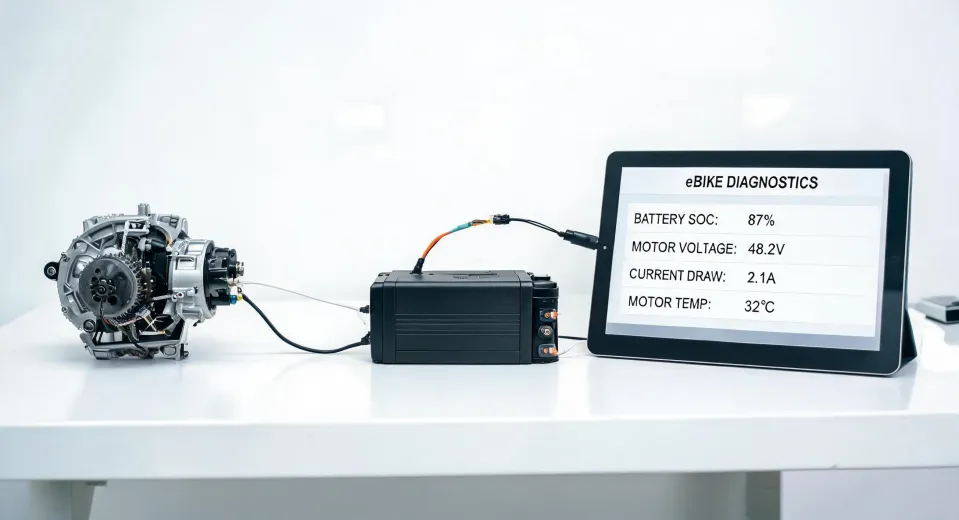
- Diagnostics access. Bosch eBike Systems offers component-level diagnostic tooling. Our technicians could identify a failed torque sensor in minutes instead of swapping parts one by one.
- Spare parts documentation. We checked for obscure components — torque sensor connectors, speed magnet brackets, motor cable harnesses. One vendor published parts lists and diagrams clearly. The other required dealer-level access. Guess which one wins in a service department?
- Software flexibility. How the drive unit handles wheel diameters, gear ratios, and support parameters matters when you're fitting the system to different frame geometries.
- Warranty administration. Who files the claim? Who pays return freight? Which failures are warranty-covered versus 'abuse'?
We chose Bosch for our 2025 model line. The diagnostic tooling, the published spare parts docs, and the claims process were things our team could verify before signing. The Yamaha system actually impressed us on ride feel — their pedal-assist response is genuinely smooth. But for our operation, serviceability and diagnostics mattered more. Your priorities may differ. That's the point — decide on criteria before you talk to a salesperson.
Even after choosing Bosch, I kept second-guessing. What if the service network was less responsive than the marketing promised? The first warranty claim happened about three months later. It processed cleanly, but the wait until that claim resolved was stressful.
Step 4: Audit the system around the motor
A motor is only as good as its electronics. For commodity steppers and BLDC motors, the hidden cost is often in the driver:
- Does the motor require a proprietary driver, or will it work with standard pulse/direction interfaces?
- Are replacement drivers available years later?
- What diagnostics does the driver provide? LED blink codes versus digital fault logging is a huge difference in service time.
- For e-bike systems: are firmware updates possible? Who manages them? Does your shop get access to maintenance history?
A $120 stepper that locks you into a $180 proprietary driver is not cheaper than a $160 motor that works with a $60 open-interface driver. Compare the system, not the component.
Step 5: Read the warranty fine print — twice
Nobody in procurement enjoys warranty terms. It's the section everyone skips. I force myself to read it once for coverage, once for exclusions.
- What voids coverage? Moisture, dust, power surges, modified wiring — read the full list.
- Does the warranty start at invoice date or commissioning date?
- Where does the failed unit go — a local distributor or an international repair center?
- Who pays return shipping?
- What do you get back — new, refurbished, or 'functionally equivalent'?
In 2024, a vendor offered us 'free setup' on a batch of e-bike drive units. The setup itself was waived. But each unit required a firmware activation code sold separately — $45 per unit. On a 10-unit order, that's $450 of 'free setup.' I should have caught it earlier. I didn't.
Step 6: Verify claims with certifications and reference calls
A datasheet is a marketing document. Treat it as such.
I check standards compliance — NEMA frame sizes for steppers (NEMA 17, 23, 34 — critical when your machine has a motor mount cut to standard); IEC efficiency classes for industrial motors, because they directly affect electricity costs; and, for e-bike drive systems, EN 15194 in Europe and UL 2849 in the US. Ask the supplier, in writing, which standards the system meets, and request the actual test report.
Then do the reference calls. Don't skip these. Ask another manufacturer using the same motor in a similar application:
"What's your unscheduled downtime per year? What fails most often? How long did the last warranty claim take to resolve?"
Reference calls have caught more problems in my procurement history than any contract review. One motor looked great on paper — then a reference mentioned that the 'IP67'-rated unit seized when mounted in a washdown orientation because the cable gland drained into the housing. That's the kind of thing you pay thousands to learn the hard way.
Common mistakes to avoid
From my own failures and from the ones I keep seeing in procurement reviews:
- Sizing on peak torque instead of continuous torque. Peak torque is a short-term capability, not a sustainable rating. Most of the motor failures I've dealt with were thermal, not mechanical.
- Ignoring the controller cost. Compare the system, or don't compare at all.
- Oversizing for 'safety.' A bigger motor isn't automatically safer. It draws more power, costs more, and can create control problems. Match the motor to the load.
- Not questioning lifetime claims. Honestly, I'm not sure why some vendors quote lifetimes far above the industry norm. My best guess is they're using optimistic internal temperature assumptions. Ask for the MTBF report and its test conditions — then do the math yourself.
- Assuming an e-bike with a Bosch motor is just a motor. It's a system — motor, battery, display, controller, sensors. Make sure the supplier certifies the complete system, not just the drive unit.
Final thought
This checklist isn't revolutionary. Each step is straightforward. The hard part is doing them consistently when a production manager is standing over your shoulder asking where the parts are.
What changed for me was that first failed order. The $900 I saved on the purchase price was a bad trade — the $1,200 rework bill plus a week of downtime made it the most expensive 'bargain' we've ever booked. Build the spreadsheet, follow the checklist, verify everything. Boring procurement practice wins every time.
Prices and standards referenced here are from my purchasing records and industry standards as of early 2025. Regulations change — verify current requirements with the official standards bodies (EN 15194, UL 2849, NEMA) before making commitments.