Buying Electric Motors and Drive Components? A 5-Step Purchasing Checklist
· Elena Markovic
-
Step 1: Define the Application Before You Look at Parts
- Step 2: Map the Motor Family to the Job
-
Step 3: Check the Sensor and Feedback Chain (the one everyone skips)
-
Step 4: Don’t Get Caught on the Transmission Bits
-
Step 5: Choose a Supplier Who Knows Their Own Boundaries
-
Common Mistakes That Actually Cost Me Money
-
The One-Page Quick Checklist
When I first started handling procurement for our company’s motion-control components in 2020, I assumed the fastest quote was the best quote. You know the logic: if a vendor gets back to you within an hour with a good price, they must have their act together. Two delayed production lines and one air-freight disaster later, I reversed my opinion. Speed on a quote tells you nothing about whether the part will actually do the job.
I’m the office administrator for a mid-sized manufacturing company, about 260 people across two locations. That means buying for motors, drives, belts, and related motion components lands on my desk—roughly $1.2M a year across 60-80 purchase orders. I report to both operations and finance, so when something goes wrong, I hear about it from two directions.
This article is the checklist I actually walk through before ordering any electric motor, drive system, or transmission part. It’s not a textbook list—it’s the one I wish I’d had when I started, with five steps in the order I do them.
When this checklist helps: you’re buying brushless AC motors, stepper motors, e-bike drive systems, V-belts, or something related to power transmission, and you want to get it right the first time.
Step 1: Define the Application Before You Look at Parts
The biggest mistake I see—and the one I made repeatedly—is leading with parts, not the problem. People ask for "a brushless AC motor" before they can say what the motor needs to do. That ordering matters.
Ask these four questions first:
- Duty cycle: How many hours per day will this run? A motor that runs 16 continuous hours is a completely different machine from one that runs 16 minutes a day.
- Load type: Constant load, variable load, or start-stop? High starting torque can rule out some motor families entirely.
- Environment: Dust, heat, humidity, washdowns? I once ordered a motor without checking its IP rating. The motor was fine. The environment wasn’t.
- Speed control: Do you need adjustable speed? Fixed speed? Precise positioning? That single answer steers you toward different motor families (more in Step 2).
Write those four things down before you email any supplier. It’s the difference between a spec conversation and a guessing game.
This applies to e-bikes too. If you’re sourcing an ebike with Bosch mid drive for a company fleet, you’re looking at cycling duty: pedal loads, stop-and-go traffic, weather, and rain. Same physics as industrial motors, very different design priorities. Defining the use-case first turns a catalog browse into a short spec sheet.
Step 2: Map the Motor Family to the Job
I’m not an engineer. I’m the person who turns engineering requests into purchase orders and then explains why deliveries are late. But after five years of managing these relationships, I’ve learned enough about motor families to hold my own. Here’s the cheat sheet I wish someone had given me in 2021:
Brushless AC Motors
Brushless AC motors (often labeled BLDC or PMAC) are the workhorses of modern motion control. They’re efficient, quiet, and durable, with no brushes wearing out inside. You’ll find them in pumps, conveyors, fans, and—notably—in most mid-drive e-bike systems. A mid-drive unit like the Bosch one contains a highly refined brushless motor with reduction gearing and torque sensors wrapped around it.
Stepper Motors
If you’ve ever asked "what’s a stepper motor?"—don’t feel bad, I did the same until I looked it up on a slow afternoon. A stepper motor rotates in small, precise increments, or "steps." That makes it ideal for positioning jobs: 3D printers, CNC machines, camera systems, anything that needs to move to an exact spot and hold it.
Steppers are typically open-loop: you command a position, and it goes there, with no feedback confirming it arrived. That’s why they’re cheap and reliable. The catch: if the load exceeds the motor’s torque, it can silently lose steps—critical in high-speed or dynamic-load work.
Servo Motors
Servo motors are the closed-loop cousins of steppers. They use feedback from an encoder or resolver to verify position and speed continuously. They cost more but handle changing loads with far more grace. If someone asks me "what’s a stepper motor vs. a servo?" I give the two-word answer: feedback loop.
I don’t have hard data on industry-wide failure rates by motor type, but based on our purchase orders and warranty claims over the past four years, my sense is a big share of motor returns trace back to spec mismatch, not manufacturing defects. That’s why this step matters.
When pricing these out (quotes from major automation distributors as of January 2025), a typical NEMA 23 stepper runs about $25-80; a 1-5 kW brushless AC motor lands around $300-1,500 depending on brand and IP rating. Prices move fast—verify current quotes before budgeting.
Step 3: Check the Sensor and Feedback Chain (the one everyone skips)
Honestly, this is the step most buyers ignore, and the one that cost me the most sleep. You order the motor, park it on a shelf, wait for the rest of the system—then discover the speed sensor you need is a different generation and doesn’t talk to the controller. (ugh)
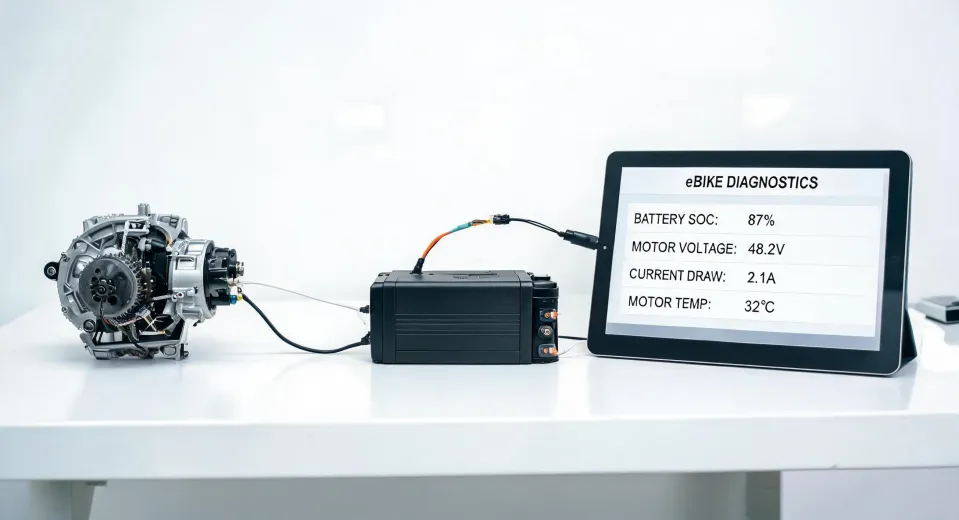
Motors don’t run alone. They need controllers, encoders, and sensors to deliver precision and safety. The bosch ebike speed sensor is a perfect example. If you’re evaluating an ebike with Bosch mid drive for a fleet or product line, that little sensor—typically a magnet-and-sensor pair on the rear wheel (some newer systems measure speed internally)—tells the drive unit how fast the bike is actually moving. No sensor signal, no assist. Worse, some systems throw an error code and shut down.
Three checks before you order any sensor:
- Compatibility. Does this sensor match the exact motor and controller generation? Part numbers that look similar are not the same—check revision levels. I’ve seen perfect parts returned because they were one revision behind the firmware.
- Connector standard. Pinout, connector type, cable length. I once spent $400 on sensors with the right specs and the wrong connector. The supplier pointed out that the catalog page clearly listed the connector type. My fault (unfortunately).
- Spare availability. If this sensor fails in the field, how fast can you ship a replacement? If the answer is "we’ll order from the factory," get the number of weeks on paper. "Four to six weeks" should scare you if downtime is expensive.
Plus, ask for the current part numbers in writing. A sensor that was standard in early 2024 may already be superseded by January 2025.
Step 4: Don’t Get Caught on the Transmission Bits
The motor gets all the attention, but the rest of the drivetrain is where things quietly go wrong. This was my most expensive lesson—not because belts are pricey, but because unplanned downtime is.
V-belts are the classic example. We order V-belts several times a quarter, and they seem simple. They are not. V-belts come in different cross-sections (classic A, B, C, plus the narrower 3V, 5V, 8V designs), and the pulley grooves must match the belt profile. If someone forces an A belt into a B groove because it "kinda fits," you’ll be replacing belts—and maybe a motor. It’s a gamble that always ends in maintenance.
What I check on every belt order:
- Profile / section type (must match the pulley groove)
- Pitch length, not outside length—pitch is what determines the match
- Center distance tolerance (new belts stretch)
- Case lot quantity (belt pricing drops notably with quantity)
- Operating temperature range (standard V-belts don’t love heat)
And ask about the pulley. A worn, galled, or misaligned pulley will eat new belts no matter how carefully you ordered them. If maintenance is ordering belts sooner than expected, the belt isn’t the problem—the pulley or alignment is.
A brushless AC motor driving a fan or conveyor is only as reliable as the coupling between it and the load. Check the coupler, guard, and alignment before you sign off.
Step 5: Choose a Supplier Who Knows Their Own Boundaries
This one took me the longest. It pushes against the "one-stop shop" instinct that’s drilled into purchasing. But after years of vendor management: I’d rather work with a specialist who knows their limits than a generalist who overpromises everything.
When we evaluated drive system suppliers for a proposed e-bike shuttle fleet in 2024, we spoke to several vendors. The usual pitch: "we do everything—motors, belts, drives, e-bikes, automation, you name it." One representative (Bosch, notably) said something different: "E-bike drive systems are where we go deep. For your industrial transmission needs, that’s not our core—here’s who we’d bring in for that part."
Seeing those two approaches side by side, same project, same week, made me realize how much money I’d spent on comfortable overpromises elsewhere. The vendor who admits "this isn’t our strength—here’s who does it better" earns my trust for everything else. We ordered the Bosch e-bike drive system with mid-drive motors and speed sensors because the line between their strength and the rest of the system was clear. No one tried to upsell us into gearboxes we didn’t need.
So my advice: ask every potential supplier, "Where are you strongest, and where should we look elsewhere?" The credible ones will tell you. The ones who say "we’re excellent at everything" are either rare geniuses or a red flag.
(As of January 2025, Bosch eBike’s published scope remains focused on e-bike drive units, batteries, displays, and accessories for street and urban cycling. Verify current coverage at bosch-ebike.com.)
Common Mistakes That Actually Cost Me Money
A few more lessons that didn’t fit neatly into the steps:
Mistake #1: Picking the fastest quote instead of the right spec. Quote speed doesn’t equal accuracy. This bit me twice before I learned it.
Mistake #2: Ignoring lead time. Typical lead times on motors and drives from our suppliers run 3-8 weeks as of January 2025. Confirm current lead times at order time and plan for the worst case.
Mistake #3: Spec’ing a motor too close to its rating. If your load draws 14.5 kW, don’t order a 15 kW motor. Step up. The headroom costs less than a failure. (Standard engineering margin considerations per NEMA MG 1-2021; verify with a qualified engineer.)
Mistake #4: Not checking the pulley before ordering belts. New belts on a worn pulley is wasted money.
Mistake #5: Not asking for the complete solution list. "Motor" means motor. But the system needs a controller, a sensor, a coupler, maybe a VFD. Ask what’s included and what’s extra.
The One-Page Quick Checklist
Here’s the version I keep on my desk.
- [ ] Application defined: duty cycle, load type, environment, speed control
- [ ] Motor family chosen: brushless AC, stepper, servo, or DC brushed
- [ ] Sensors and feedback verified: compatibility, connector, spare availability
- [ ] Transmission checked: belt profile, pitch length, pulley condition, alignment
- [ ] Supplier boundaries confirmed: for this specific order, where are they strong?
- [ ] Lead time confirmed, including current date on pricing
- [ ] Complete solution list in writing: motor, controller, sensors, cables, transmission
Bottom line? Use this list. The five steps look simple, but they catch 80% of the problems I’ve hit in actual purchasing. Done.