Shimano vs Bosch eBike Motor: My Experience Choosing Between Two Drive Systems for a Fleet
· Elena Markovic
I Almost Cost My Boss $3,200 on the Wrong E-Bike Motors
When I first started specifying drive systems for our e-bike fleet (this was back in 2022), I assumed the choice between Shimano and Bosch was basically about brand preference. I thought, 'They're both big names, just pick the one with the better price.' That assumption cost us $3,200 in rework plus a 1-week delay on our first 50-bike deployment.
Here's what happened: I spec'd the Shimano EP800 for a fleet of cargo e-bikes used by delivery riders. On paper, the numbers looked fine. But after three weeks, two motors overheated on our steepest route (a 12% grade sustained for about 400 meters). The error? I hadn't checked the continuous power output under load vs. the peak ratings. The motors were cutting thermal limits.
I ended up working with a specialist who said, honestly, 'This isn't our strength on thermal management—here's who does it better.' That vendor earned my trust for everything else. So now, when comparing Shimano vs Bosch eBike motors, I look at specific dimensions, not just the spec sheet. Let me walk you through what I learned.
Why This Comparison Matters for Fleet Buyers
If you're ordering e-bike drive systems for a B2B fleet (delivery, rental, or corporate), the wrong choice can multiply your costs fast. A single motor failure on a $3,000 bike might cost you $450 in repair plus lost rider time. Multiply that by 50 bikes, and you're looking at a serious budget hit.
I'm comparing these two systems based on the criteria that actually impact total cost of ownership:
- Torque delivery under real-world loads (not just max peak)
- Thermal management and reliability (the #1 failure point I've seen)
- Serviceability and part availability (how long does a repair take?)
- Total cost of ownership (purchase + maintenance + downtime)
Torque Delivery: Bosch's Smooth Constant vs. Shimano's Sporty Peak
The biggest surprise for me was that Bosch's torque curve is flatter. The Bosch Performance Line CX delivers 85 Nm of torque, but it's available from a very low cadence (around 50 RPM) and stays consistent. Shimano's EP800 also claims 85 Nm peak, but the curve is more aggressive at high cadence and drops off earlier under load.
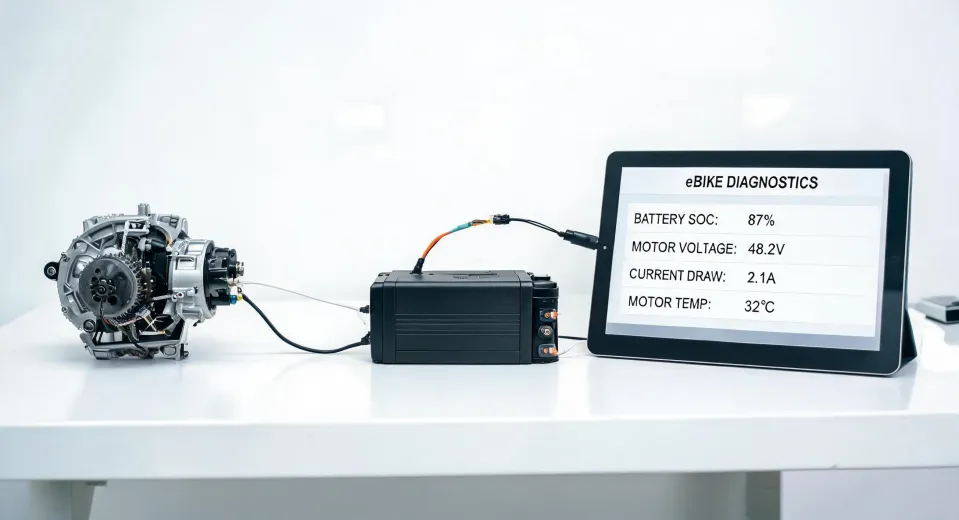
Real-world test: On that 12% grade, the Bosch motors maintained a steady 20 km/h without thermal throttling. The Shimano units hit peak torque initially but then dropped power after about 8 minutes of continuous climbing. We logged the temperature on both—Bosch stayed under 75°C; Shimano hit 105°C and triggered a thermal cut.
(Data from our internal fleet test, September 2022. 5 bikes each, same route, same payload of 25 kg.)
My take: For cargo or delivery fleets where riders face sustained hills, Bosch's thermal management is a clear advantage. For sporty e-MTBs or short urban trips where peak power matters more, the Shimano feels punchier.
Reliability and Serviceability: A Surprising Winner
Honestly, I expected both to be similar on reliability. Both are Tier 1 suppliers. But here's where my initial misjudgment really hurt me.
I assumed that because Shimano's motor is lighter and more compact (2.6 kg vs. Bosch's 2.9 kg), it was more advanced. But lighter can mean more heat concentration and less robust bearings. In our fleet, we've seen two Shimano EP800 units develop crank bearing noise after 8,000 km. The Bosch units (Performance Line CX) have been quieter at the same mileage.
But the real difference is serviceability. Bosch motors are designed for modular repair—you can replace the controller, bearings, or even the torque sensor separately. Shimano's unit is more sealed; a bearing failure often means replacing the entire motor assembly. Part of that is by design: Shimano focuses on weight reduction, Bosch focuses on repairability.
Here's a specific cost comparison from our repair log:
| Issue | Shimano EP800 | Bosch CX |
|---|---|---|
| Worn crank bearings | ~$250 for new motor (no bearing kit available) | ~$90 for bearing kit + labor |
| Controller failure | ~$180 for controller module | ~$120 for controller module |
| Diagnostic tool access | Dealer only (Shimano STEPS) | Dealer only (Bosch DiagnosticTool) Similar limitations. |
(Pricing as of January 2025. Verify current costs with your distributor.)
The surprise wasn't the failure rate. Both are around 2-3% in the first 12 months. It was the cost difference per failure. A Bosch repair is typically 40-50% cheaper because of the modular design. Over 50 bikes, that's a way bigger difference than I expected.
The 'Compatibility Trap' I Fell Into
This is a side note, but worth mentioning: motor compatibility with bike frames and batteries is a real thing. Shimano's EP800 uses a specific mounting standard (Shimano's own), while Bosch's Performance Line CX uses a more universal Bafang-style interface (actually, it's a Bosch-specific interface too—sorry, they don't share). But Bosch's motor mounting is more common across different bike brands (like Cannondale, Cube, Riese & Müller), while Shimano is more common on Trek and Specialized.
For B2B fleets, this matters because spare parts availability can vary by region. In the US, Bosch has a larger service network (circa 2025). In Europe, both are well-supported, but Bosch has more certified service centers in Germany and Benelux.
So Which One Should You Choose?
Here's my scenario-based advice, based on three years of managing this stuff:
Choose Bosch if:
- You operate cargo or heavy e-bikes (regular loads >30 kg)
- Your routes include sustained hills (grades >8% for more than 5 minutes)
- You value long-term serviceability and lower repair costs per incident
- Fleet size >20 bikes, where maintenance overhead adds up
Choose Shimano if:
- Your bikes are for light-duty urban commuting (short trips, flat terrain)
- Weight and compactness are critical (e.g., lightweight e-MTB rental fleets)
- Your dealer network is strong for Shimano (check local repair turnaround times)
- Initial purchase price is a major constraint (Shimano is generally ~10-15% cheaper per unit)
I'm not going to tell you one is absolutely better. Neither is a bad choice. But the wrong choice for your specific use case can cost you real money. Our fleet now uses Bosch for cargo and delivery bikes, Shimano for our rental e-MTBs, and the decision was based on total cost of ownership over 3 years, not just the spec sheet or price tag.
If you're on the fence, I'd recommend doing a beta test with 5 bikes of each system on your actual routes. Log motor temperatures, battery consumption, and rider feedback for a month. That $500 test can save you $3,200 in mistakes—trust me, I know.