Our New Bosch E-Bike Motor Failed in Six Months. The Real Problem Wasn't the Motor.
· Elena Markovic
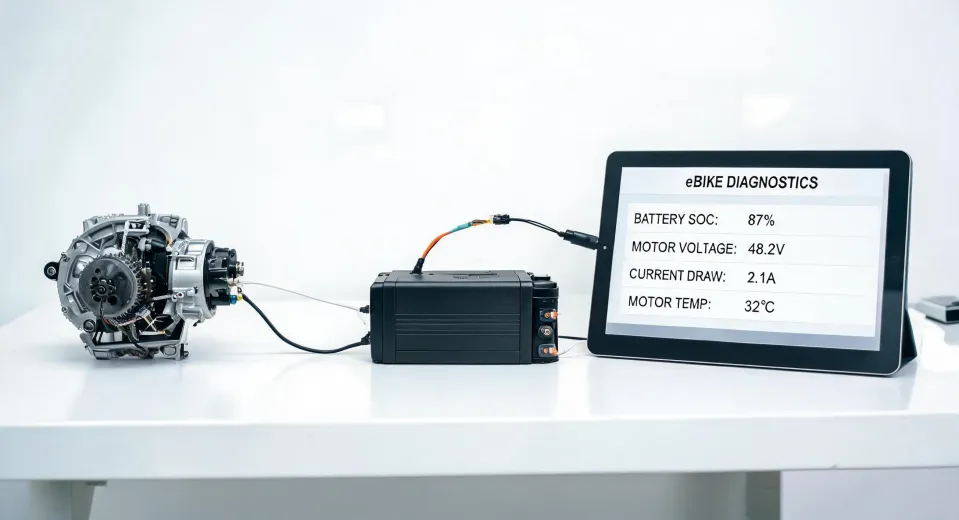
I manage purchasing for a mid-sized logistics company—about 90 employees, a small e-bike delivery fleet, and a workshop with conveyors, pumps, and a lathe that's older than I am. I process 60-80 orders a year, and motor-related purchases are a bigger slice of that than you'd think.
So when our newest e-bike—fitted with a brand-new Bosch e-bike motor—threw a drive fault in under six months, I did what I always do: I blamed the motor. "Premium brand, premium price, and it dies in half a year?" I said that to our maintenance lead, probably a little too loudly.
That was the surface problem. The real one took another motor replacement and a very painful invoice to uncover.
What I thought was happening
The first failure was covered under warranty, but it kept the bike down for two weeks. The second drive unit failed three months later—out of warranty this time. We paid $1,400 for the replacement drive unit (which, honestly, felt steep for a motor rated at 250W nominal), plus $220 for the sensor kit and $180 in labor.
Three months after that, the replacement showed the same fault code.
That's when our maintenance lead finally looked past the motor. The real culprit was the Bosch e-bike speed sensor (the little magnetic pickup that reads wheel rotation and tells the drive unit how fast you're going). The magnet on the wheel was cracked, and the connector was corroded. The sensor was sending erratic signals—the motor thought the bike was stopping, then accelerating, then stopping again. Every correction hammered the drivetrain, and over time, the stress cooked the drive unit.
The motor didn't die because it was a bad motor. It died because it was getting garbage data and trying to compensate.
The pattern I started seeing everywhere
Once I saw that, I couldn't unsee it. The same thing was happening on the industrial side, with a different label on the box.
We'd burned through three brushless motors on a conveyor feed table in two years. Same story each time—motor seized, we replaced it, it seized again. Nobody asked why until the third one. Shaft alignment was off by about four millimeters and the belt tension was too high. The motor was the victim, not the cause.
We bought a linear stepper motor for a positioning actuator that worked perfectly on the bench and stalled under real load. We'd undersized it—rated for 30N, application needed 80N, and nobody checked the force curve at operating speed.
And then there was the VFD.
Our facilities guy asked me, "What size VFD for 5HP motor?" I bought a 5HP VFD. Sounded correct. The motor ran, but the drive tripped on overcurrent every few hours. Turned out the pump had a high starting torque profile, and the VFD—matched by horsepower alone—wasn't rated for the load class. The question itself was incomplete. It should've been: "What size VFD for this motor, under these load conditions?"
The real cost of buying parts instead of systems
Here's where the problem stops being technical and starts being financial.
Going through our 2024 numbers:
- Bosch e-bike drive replacement: $1,400 drive unit, $220 sensor kit, $180 labor, plus roughly $600 in missed deliveries across two weeks of downtime.
- Conveyor motor pattern: three motors at about $340 each, plus 12 hours of maintenance overtime, plus line stoppages nobody wanted to calculate.
- VFD blunder: a $310 field visit from a controls contractor to tell us what a datasheet review should have caught.
Then there's the softer cost. When you're the person placing the orders, and the thing you ordered keeps failing, the shop floor starts joking about "the motor lady." It's not mean-spirited, but it stings. And when I had to walk into my VP's office with a $2,100 requisition to re-fix a problem we'd already paid to fix, that was not a comfortable conversation.
I knew I should've gotten the sensor gap checked after the first motor swap. But I thought, "It's Bosch. What are the odds the install is the problem?" The odds caught up with me. Twice.
The problem behind the problem
Every example I just listed has the same root cause, and it isn't the hardware. It's the way we were buying it.
A motor is one element in a system: motor + drive + feedback + mechanical coupling + load profile. When one link in the chain is wrong, the motor takes the blame because it's the part that physically gives out.
I've never fully understood why this is so counterintuitive, even for me. My best guess is that motors look like stand-alone parts. They have a shaft, a housing, and terminals. It kinda feels like a complete thing. But the spec sheet won't tell you if it'll survive your belt tension, your VFD's carrier frequency, or your sensor's signal quality.
For what it's worth, the Bosch failure was the most instructive. Their drive units are genuinely well-engineered—the documentation, the protection, and the reliability are better than anything else we've run. The problem was sensor mounting, and honestly, the problem was our own sloppy install. The sensor magnet was slapped back on without checking the air gap to the sensor. The installation spec calls for a precise gap—about a credit card's thickness, if I remember right, and I'm not going to pretend I have the exact tolerance memorized. We didn't check. The motor paid for it.
A better way to buy
You don't need to become a motor engineer to avoid this. You need to change the questions you ask before you hit "submit order."
- Describe the application, not just the part number. What's the duty cycle? What's the load type? What's the environment? A motor used intermittently on a pallet line is not the same motor running continuously on a pump.
- Ask for the system view. Buying a brushless motor? Ask about the controller and feedback. Buying a VFD? Send the supplier the motor's full-load amps from the nameplate—that FLA rating printed on the plate per NEMA standards—not just the horsepower, and describe the load. For a 5HP motor, that's the difference between a "5HP" drive and one oversized enough to handle the start without tripping.
- Get everything in writing. If a vendor can't produce a proper datasheet and a proper invoice, walk away. In 2022 I bought a "great deal" motor from a supplier who gave me a handwritten receipt. Finance rejected the expense, and I ate $480 out of the department budget. The motor also didn't match its own label. Learned that one the hard way.
- Check the cheap stuff first. On e-bikes, that means verifying the speed sensor and its mounting before condemning a drive unit that costs 10x as much. In the industrial world, it means confirming alignment, belt tension, and VFD settings before ordering a replacement motor.
The satisfying part? After these failures, we built a one-page pre-purchase checklist for anything with a motor, drive, or sensor. Motor-related spend dropped about 40% in the second half of 2024—no more emergency units, no more repeat failures, no more "motor lady" jokes.
There's something satisfying about that. After all the stress of watching parts fail and the budget take the hit, finally having a process where the right part shows up, works, and stays working is its own kind of payoff. The details matter—every purchase we make is a reflection of our company to the people who depend on us. If we don't take the system seriously, we're telling them we don't take them seriously.