Emergency Drive System Replacement: A 5-Step Checklist for When Every Hour Counts
· Elena Markovic
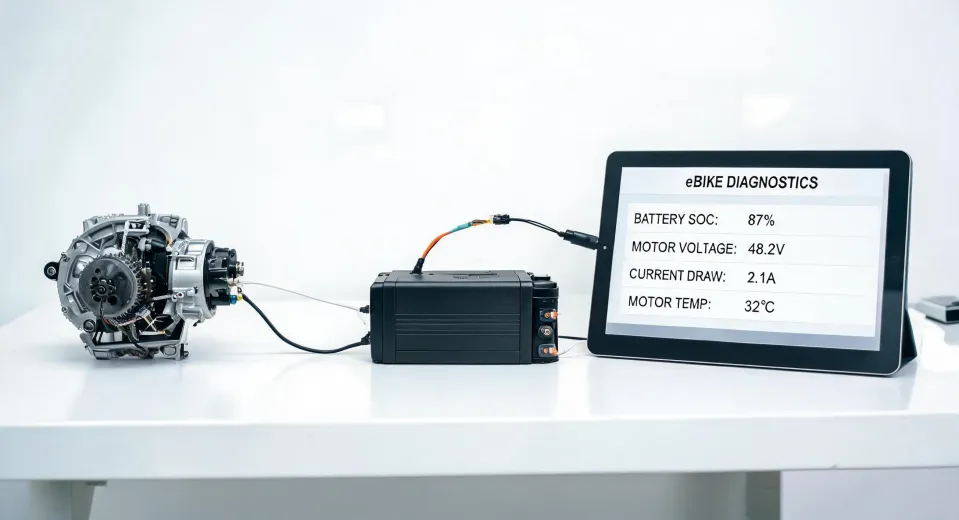
This is for the person who answers the phone at 3pm on a Friday. A production line is down, an e-bike dealer just lost a warranty repair slot, and the customer needs the unit by Monday. I've been that person for about 200 rush orders over the past eight years, mostly in industrial drive components and e-bike drive systems. I'm not an engineer — I'm the guy who sources the parts, pays the rush fees, and makes sure the delivery meets the deadline. My experience is based on mid-size orders in the US and EU. If your supply chain runs differently, treat this as a starting point, not gospel.
The checklist below has five steps. It's not about design theory. It's about what to do when the clock is running.
Step 1: Verify what's actually broken
My first rule: never order a replacement part until you know what failed. It sounds obvious, but in a panic, people replace a motor when the real issue is a VFD fault or a loose connector.
- Read the nameplate and take a photo. You need the exact model, voltage, current, speed, and IP rating.
- Spin the shaft by hand. Does it turn freely? Grinding noise is mechanical failure. Silence could be electrical.
- Check the windings with a multimeter. An open winding is one thing; a short to ground is another.
- Run the diagnostic tool for e-bike motors. On Bosch systems, the display often points to a controller issue before the motor itself is suspicious.
Ask yourself: is the part the victim or the cause? I once replaced a gearbox on a conveyor, only to find the motor above it was the one delivering zero torque. That mistake cost two days.
Step 2: Choose a replacement strategy: repair, replace, or upgrade
Once you know it's a genuine failure, decide quickly.
Repair if the damage is limited to a bearing, seal, or controller board and the part is out of production. Replace if the repair cost exceeds 60% of a new unit, or if a replacement aftermarket part is already on hand. Upgrade only if you have plenty of time. In an emergency, you don't want to be the first to fit a new model. “Better” can mean different mounting dimensions, different connectors, different software.
For e-bike drives, this decision is usually brand-locked. If the bike has a Bosch Performance Line, you can't just drop in a Brose or a Shimano motor without replacing the controller, display, and sometimes the battery. I get asked about Brose vs Bosch e-bike motor options a lot. Both deliver solid performance, but in a time-critical replacement, the real question isn't which brand is better—it's which system is already on the bike. Don't turn a two-day repair into a two-week conversion.
As for Bosch e-bike motor cost: it's not a fixed list. From what I've seen in 2024-2025 quotes, a replacement Performance Line CX unit runs roughly $1,500–$2,500, without labor. Brose units are sometimes $200–400 less, but supply can make pricing irrelevant. If the motor is still under warranty, explore Bosch's exchange program before paying retail.
Step 3: Source the part, in the right language
This is where language can bite you. If you're buying from a Spanish-speaking supplier and you need a timing belt in Spanish, don't call it a “belt” and hope for the best. In industrial settings, use “correa dentada” for a timing/synchronous belt, “correa trapezoidal” for a V-belt, and “correa de distribución” specifically for engine timing belts. I once watched a vendor quote a V-belt when the customer had asked for a timing belt in Spanglish. That mistake is easy to avoid.
For off-the-shelf components, reference the part number directly. Take the Dayton AX22 cogged V-belt. That's a common light-duty cogged V-belt with a 22-inch outside circumference and a 1/2-inch top width. It fits fractional horsepower pulleys and is stocked by most industrial distributors. If you need one overnight, that part number is worth more than a full description.
Also check the revision. Manufacturers change designs. A “same part number, newer revision” can have different dimensions. Photograph the old part, the plate, and the connector layout.
Step 4: Cost it out like a rush job
Rush pricing feels arbitrary, but it follows patterns. Based on quotes I've seen in the last 12 months, next-business-day freight adds 25–50% to the component cost, and same-day freight can double it. That's before overtime labor.
The standard rule I apply: if the rush fees don't push the total above 10% of the production downtime cost, just pay them. I've pulled the trigger on a $350 VFD with $120 same-day freight because the line was worth $12,000 an hour. It was an easy call.
For e-bike repair, remember the hidden costs: removing a Bosch drive unit often means dropping the bottom bracket, and that's an hour or two of labor even for someone who's done it before. Add $100–$200 for shop labor if you're quoting a customer. It's better to quote a conservative total and beat it than to surprise them later.
Step 5: Install and confirm with the right drive settings
When the part arrives, install carefully, then verify the actual performance. This is where I've learned to slow down.
First, write down the wiring before you disconnect anything. Label the wires. You'd be surprised how many motors turn backwards because of a last-minute swap.
If you're working with an industrial motor and a VFD, here's the practical part: how does a VFD control motor speed? A variable frequency drive changes the frequency of the power to the motor. The motor's synchronous speed is proportional to frequency, so higher frequency = faster speed. Most VFDs keep a constant voltage-to-frequency ratio, which means torque stays roughly constant up to the motor's base speed. If you set the VFD's max frequency above the motor's rated frequency, the motor will run above its base speed, but torque starts to drop. For a quick start, set the base frequency to the motor's nameplate rating (usually 60 Hz in North America, 50 Hz elsewhere), set the max frequency to what the application actually needs, and test the rotation direction.
For e-bike motors, don't skip the software check. A new Bosch drive unit has to be registered and assigned to the bike using the manufacturer's diagnostic tool; otherwise the system won't give full power or might not start at all. That's not optional.
Common mistakes I still see
- Ordering the replacement before checking whether the old part is really dead. Again: photograph, measure, test.
- Forgetting the little pieces. Connectors, o-rings, shaft keys, or firmware updates. The motor arrives and can't be installed because of a $3 part.
- Ignoring the IP rating. A motor from a dry indoor line won't survive a wash-down area.
- Not checking lead times before promising the deadline. Use the vendor's real quoted time, not the web site's default.
My experience is based on hundreds of orders with businesses that were willing to pay for speed. If you're in a low-margin, high-volume operation, your threshold for rush fees will be different. Know your break-even number before you call.
There's a quiet satisfaction in beating a crazy deadline. The stress of a Friday emergency fades; the fact that the line ran on Monday morning remains. Just remember: the job isn't done until the motor spins the right way and the VFD logs a clean run. After that, it's just another day.
If you need an engineer for the design side, bring one in. My strength is the logistics, not the physics. That boundary is exactly why the parts show up on time.