The $640 Motor That Cost $3,200: Why Unit Price Is a Trap in Drive-System Buying
· Elena Markovic
Last spring, I approved a $640 purchase order for an AC servo motor. By the time that motor was actually doing its job on one of our production lines, it had cost us around $3,200. Not because the motor was defective. Because I compared the wrong column on the quote sheet.
I'm the office administrator for a 340-person manufacturing services company. Last year I managed about $900K in vendor spend across 11 categories — from copy paper to replacement drive components to a small fleet of e-bikes our maintenance crew uses around a 14-acre campus. I report to both operations and finance. That means I get to pay for the same mistake twice: once in the budget, and once in the plant manager's office.
I'm sharing this because drive-system buying is full of landmines that don't show up in a spec-sheet comparison. If you think a 250W motor is just a 250W motor, keep reading.
The $640 Motor That Was Never $640
It started with a requisition from our senior maintenance tech. A machine on line 3 had a failing drive motor. He wrote "Kollmorgen servo motor" on the form — that was the brand that had run on that machine for 11 years. I did what any responsible buyer would do: I got three quotes.
- $640 — a "compatible" AC servo motor from a brand I'd never heard of.
- $780 — the Kollmorgen servo motor the tech actually asked for.
- $950 — a Bosch AC servo motor package from a local distributor.
The specs looked identical. Same frame size, similar torque curve, same feedback type. The $640 option even said "drop-in replacement" — which, honestly, should have been my first red flag. Nothing in industrial automation is ever a drop-in replacement. At the time, though, the price seemed like a no-brainer.
So I chose the $640 motor. Here's what happened next:
- The connector didn't match the existing drive. $45 adapter.
- The adapter needed a custom wiring harness to handle the feedback signal. $100.
- The motor spun, but the axis oscillated. The drive's tuning parameters didn't transfer — the motor's electrical characteristics were different enough to matter. Our electrician and a plant engineer lost two days to it.
- The seller's "technical support" turned out to be a one-page PDF and a promise that an engineer would call back. The call never came.
- An outside controls engineer fixed the tuning in a single five-hour visit. $850. Before he left, he said: "You'll always be fighting this combination."
Add it up: $640 + $45 + $100 + $850 in invoices, plus two days of a line running at half speed. Operations quietly estimated the lost throughput at $1,500. Total: about $3,135.
The cheapest motor ended up costing more than five times its own price — enough to buy the most expensive quote three times over. And I still don't know if the $640 motor was actually bad. I just have no way to find out, because nobody who sold it would answer the phone.
People Think the Brand Premium Is a Brand Tax. It's the Opposite.
Here's the counterintuitive part. A lot of buyers assume established manufacturers charge more because of their name — a brand tax. In drive components, I've come to believe it's the other way around.
A servo motor doesn't exist alone. It's part of a system: the drive, the feedback, the cabling, the tuning data, the spare-parts pipeline, the software, and the human being who picks up the phone when a fault code appears. The brand is a proxy for how much of that surrounding system actually works.
That's why the Kollmorgen servo motor quote was $780. It wasn't a logo tax. It was payment for decades of installed machines, engineers who know how to tune them, and distributors who stock the spares. Same logic applies to Bosch. You're not paying for the name — you're paying for the ecosystem. And in this category, the ecosystem is what fails or holds up.
Honestly, I'm not sure why the original machine builder chose Kollmorgen 11 years ago. My best guess: the OEM designed the machine around it. That's exactly my point. The machine was built for that motor, and swapping in a stranger — then hoping for the best — was where the cost multiplied.
The e-Bike Side of the Same Lesson: Bosch CX-R and the App
The same lesson showed up again this year, this time on two wheels. We replaced two pickup trucks with six e-bikes for maintenance runs across our campus. The bikes could be spec'd with either a house-brand hub motor — about 25% cheaper — or a Bosch CX-R eBike motor. On paper, both could get a technician and a toolbox across the campus.
Our facilities manager pushed back on the cheaper option. His words: "We need the data, not just the watts."
He meant the Bosch eBike app — officially called the Bosch eBike Flow app. I filed it under "consumer gimmick" at first. Running a small fleet is different from riding one bike, though. The app gives us:
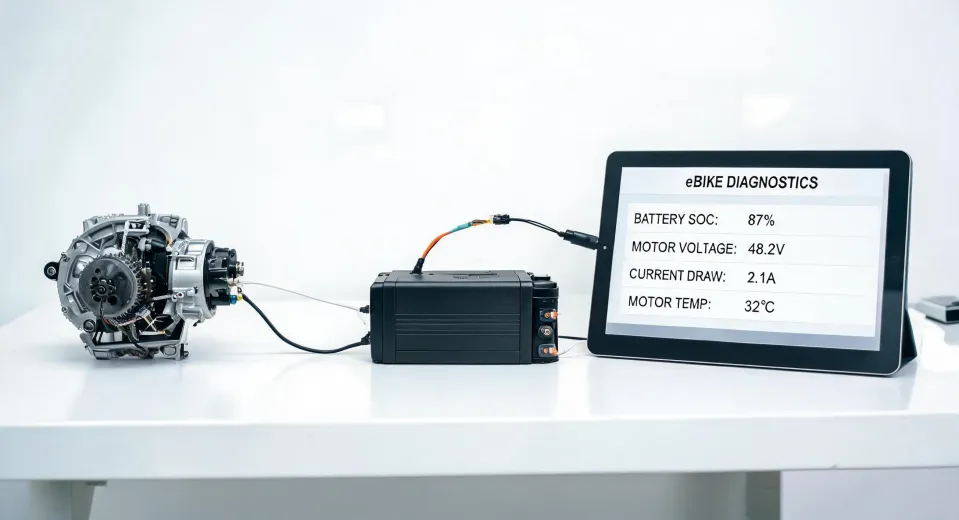
- Battery state of health per bike. We caught a pack degrading much faster than it should. The diagnostic logs supported a warranty claim — without that data, we'd have paid roughly $900 for a new battery.
- Fault codes and service reminders. We fix bikes on a schedule instead of answering mid-shift breakdowns.
- Usage data. We know which bikes actually justify their place in the budget.
So the 25% savings came at a real cost: zero visibility. Six bikes operating blind. In a B2B environment, blind operation isn't a bargain — it's a gamble.
In the end, we ordered the bosch-ebike Performance CX-R drive unit for all six bikes. It wasn't the cheapest option. It was the one with the data attached.
What That Ignorance Actually Costs
I've talked a lot about the $3,200 motor. The e-bike decision was the near miss that scared me more.
I was literally one click away from signing for six generic drive units — saving about $2,100 on the purchase order. If our facilities manager hadn't pushed back, we'd have saved that money and lost all fleet visibility. No battery health data. No diagnostic logs. No warranty documentation. It could easily have cost us three to five thousand dollars in the first year alone. So glad I listened to him.
Then there's the motor. I had to sit in my VP's office and explain how a purchase meant to save money had burned a $2,500 hole in the maintenance budget. That conversation was not fun. But it's the reason I buy differently now.
To be honest, I have mixed feelings about that lesson. Part of me wishes it hadn't taken $3,200 and a very awkward meeting to learn it. Another part is relieved we learned it before ordering the e-bikes.
How I Buy Drive Components Now (The Short Version)
I still buy on price. Every responsible buyer does. I just buy on total cost, not invoice cost.
Five questions before I'll sign a PO for any motor, drive, or gearbox:
- What exactly is "compatible"? If the answer includes the word "adapter" or "converter," the quote just grew by 20%. If it needs a custom cable, it grew by more.
- Who answers when the fault code appears? I call the support number before I buy, not after. (Note to self: I did not do this last year. Never again.)
- Where are spare parts stocked? If the lead time is measured in months, the quote is already over budget.
- Does the system give me data? Battery state of health, fault logs, service intervals. Data is the difference between planned maintenance and emergency purchasing.
- What's the actual TCO? Unit price + adapters + integration time + downtime risk + support + spare-part risk. A quote that's 30% cheaper with no support is usually the most expensive option on the table.
You also have to ask the technical questions, even if you're not an engineer. Take gearmotors. If someone asks you "which gear is most likely to use a spur gear?" the answer is most basic parallel-shaft reducers. Spur gears are the workhorse — simple, efficient, and relatively cheap to produce. But they're noisier than helical gears, and if the gearbox isn't sized for your duty cycle, they wear out faster. For the motor side, ask what duty class it's rated for under IEC 60034-1. A quote that can't answer those questions doesn't have the information you need to avoid a failure.
Bottom line: the most important number on a quote isn't the one at the bottom. It's the math that happens after the invoice.
If you're searching for a Kollmorgen servo motor because that's what's on your machine, that's a good instinct. If you're spec'ing a Bosch CX-R eBike motor for a fleet, ask how good the connected app is — because that's where the operational costs live. And if you're comparing gearmotors, ask what's inside the box before you ask what it costs.
One caveat: this framework worked for our context — a single-campus B2B company with a small maintenance team. If you have full onsite engineering and controls resources, you might be able to absorb a cheaper motor and tune it yourself. Your calculus could be different. Ours cost us $3,200 to figure out.