The $1,200 Bosch E-Bike Motor Upgrade Mistake: What a $4 Speed Sensor Magnet Taught Me About Total Cost
· Elena Markovic
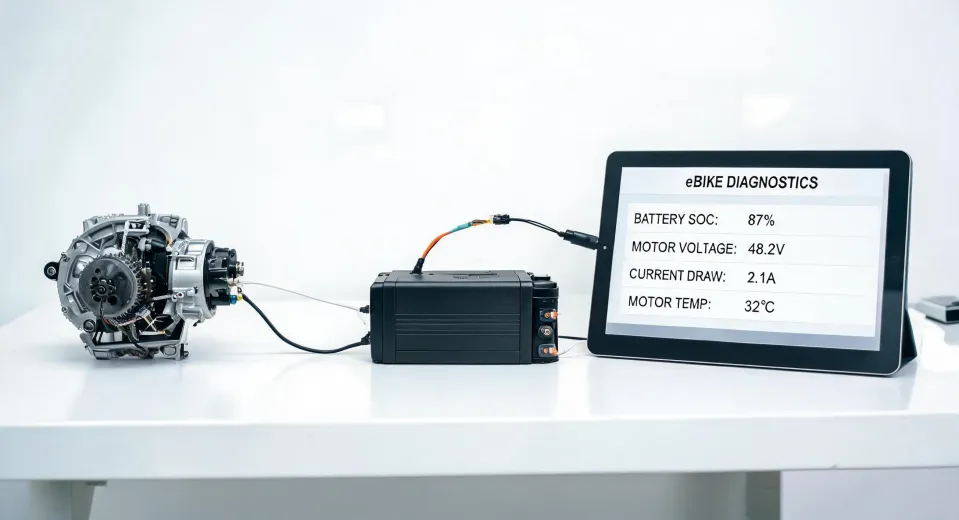
If you've ever torn down a motor that "mysteriously failed," only to watch it spin perfectly on a bench, you know the specific frustration. It's being outsmarted by your own assumptions. I've been there more times than I like to admit.
Eight years ago, I started working with electric drive systems — industrial servos first, then e-bike drivetrains, then the messy overlap in between. I've made mistakes that cost me and my customers roughly $15,000 in wasted hardware and labor. Plus the credibility damage you can't put on a spreadsheet. This one still stings the most.
When a Bosch E-Bike Motor Upgrade Went Wrong
March 2022. A local bike shop sent over a Bosch Performance Line e-bike with a complaint: the motor felt weak. Power dropped off noticeably on hills, sometimes cutting out entirely. They had just performed a bosch ebike motor upgrade — a firmware update and a new display — and the shop owner was convinced the update had damaged the drive unit.
I ran the standard checks: battery voltage, error codes, mechanical resistance. All more or less fine. The intermittent power loss kept happening during my test ride, so I assumed there was a software fault I couldn't see.
The shop said "we did the upgrade last week." I heard "the upgrade must have broken something." What he meant was "maybe check the areas we touched during the upgrade." That communication gap sent me down a two-day rabbit hole.
I went back and forth for a full day: dig deeper into the sensors and wiring, or pull the trigger on the motor. The customer was pressing. The error codes were ambiguous. A new motor seemed like the "safe" choice. My gut said keep looking. I overruled it.
I made the call: replace the drive unit.
The customer approved a $1,200 motor and a week of downtime. When the new unit arrived and we installed it, the same symptom repeated on the shop's first test loop.
The motor had never been broken.
The Real Problem Was a $4 Speed Sensor Magnet
Here's what I missed.
During the upgrade, the rear wheel had been removed for a tire service. When it went back on, the bosch ebike speed sensor magnet shifted about 3mm further from the frame-mounted sensor — just outside the working gap.
The sensor still picked up the magnet sometimes, so the speed signal cut in and out. On Bosch e-bike systems, losing the speed signal causes the controller to derate power as a safety response. The motor "felt weak" because it was being throttled by a fault it couldn't clearly report.
Bosch's official technical documentation specifies the allowable air gap for the speed sensor. I had read that page. But when I stood in front of that bike, I defaulted to the assumption that a weak motor means a motor problem — not a misaligned $4 magnet. That expensive-parts-first instinct is the real disease here.
The correct fix was moving the magnet back into position and tightening the mount. Total cost: $0. Actual money spent: $1,200 for a motor, $160 in labor, a week of the customer's riding time, and a referral relationship that stopped sending work for months.
When the malfunction points at the motor, the magnet is still cheaper than the replacement. Always check the cheap failure modes first.
The Same Pattern in Servo Motors and VFDs
If you follow servo motor news or spend time in automation forums, you'll see this same story in different packaging: someone specs a motor and drive based on a connector shape instead of the application, then pays with downtime.
Take the sg90 servo motor datasheet. This tiny $4 hobby servo gets used in everything from camera gimbals to light robotic arms. The datasheet lists stall torque somewhere around 1.8 kg·cm at 4.8V. A beginner reads that number and assumes the motor can push that load all day. In my first year, I accepted a similar datasheet rating as continuous duty and let a small actuator run near its limit. Cooked the gearbox and cost us a $600 assembly — before lunch. Stall torque is not continuous torque. Run an SG90 near its limit for extended periods and the plastic gears literally cook. The datasheet doesn't lie — but it also doesn't say "intermittent duty, hobby use, don't run hot." You have to read what's not on the datasheet.
Same story with VFDs. I get regular calls that start with "what vfd stands for?" — Variable Frequency Drive. That part's easy. The harder part is that a VFD doesn't magically fix a mismatched motor or a load you haven't characterized. Constant torque loads (conveyors, positive displacement pumps) behave differently from variable torque loads (fans, centrifugal pumps). Choose the VFD by the load profile, not just the motor nameplate.
I'm not 100% sure why this pattern is so consistent. My best guess: motors and drives look simple — two wires in, shaft spins. So buyers default to the cheapest option that matches the connector. The thermal, mechanical, and duty-cycle details come back to collect later.
Calculating What This Really Costs
Let me be direct about the price of ignoring specifications:
- $1,200 — a Bosch e-bike motor that never needed replacing
- $160 — labor for the swap
- $120 — diagnostic time that went nowhere
- $4 — the actual failure: a speed sensor magnet out of position
- 1 week — the customer couldn't ride
- 1 referral relationship — the bike shop stopped sending work for five months
If I'd checked the speed sensor magnet's position and air gap first, that entire list shrinks to zero. But the urge to solve the problem at the highest level overrode the effort of checking simple things.
My opinion after a decade of this work? The cheapest quote is rarely the least expensive decision. I'm not saying buy premium for the logo. I'm saying total cost of ownership includes installation, commissioning, downtime, and your own mistakes. You don't avoid those by buying cheaper. You avoid them by understanding what you're actually installing.
What I'd Do Differently Now
If you're planning a bosch ebike motor upgrade, replacing a servo, or adding a VFD to a production line, here's my checklist — written after paying for it in cash and credibility:
- Check the speed sensor magnet before the motor. Verify the air gap and alignment against Bosch's installation documentation. It takes 15 minutes and costs nothing.
- Read the installation manual before the datasheet. The datasheet advertises performance. The manual shows where the system breaks when the details are wrong.
- Define the duty cycle in writing. If your application runs continuously, a hobby-class servo like the SG90 is the wrong category, regardless of its torque spec.
- Size VFDs by load type, not just nameplate amps. Work with a supplier who asks about the application instead of just taking your order.
Take it from someone who funded these lessons out of pocket: the extra 30 minutes of thinking costs less than any replacement part. And the magnet is always cheaper than the motor.
One more note on parts: "compatible" is a marketing word, not an engineering one. Per FTC advertising guidelines (ftc.gov), claims must be truthful and substantiated — but a listing saying "fits Bosch e-bike" only means the physical connector matches. Magnetic and thermal characteristics can still be completely different. Verify before you install.