Motor Procurement on a Budget: A 5-Step Checklist for E-Bike and Industrial Drives
· Elena Markovic
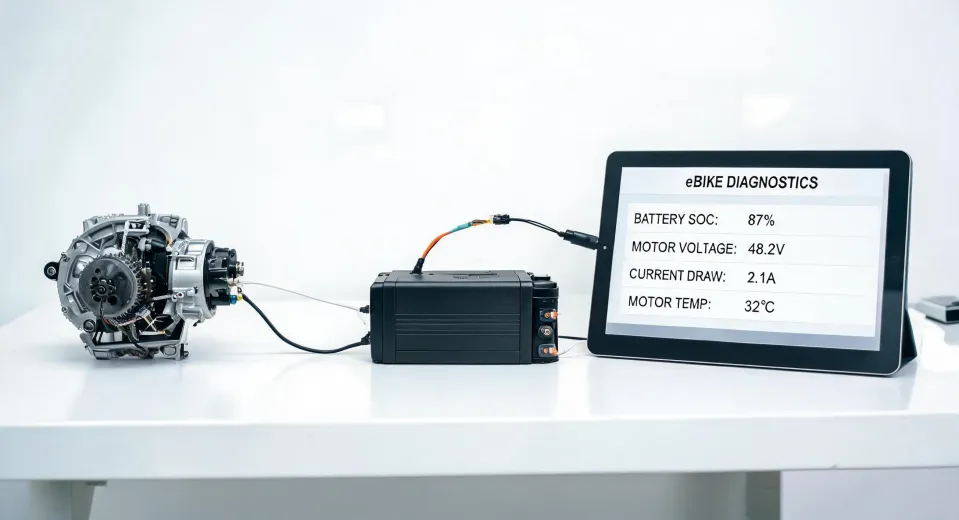
If you're the person who signs off on motors — for e-bikes, production lines, or anything that turns electrical energy into motion — this one's for you. I've spent six years as a procurement manager tracking roughly $180,000 in motor and drive system purchases. The biggest savings didn't come from hunting for the cheapest quote. They came from catching spec and compatibility problems before paying the invoice.
I'm not an electrical engineer. My job is to make sure the engineer's wish list doesn't blow up the annual budget. That means I've negotiated with more motor suppliers than I can count, documented every order in our cost tracking system, and built a cost calculator after getting burned on hidden fees twice. If you're in a similar role, keep reading.
Here's a five-step checklist I use when we compare e-bike drive units or industrial motors. It's practical, not theoretical. Use it when you're about to issue a PO for an AC motor, a stepper motor controller, a VFD, or a Bosch eBike drive unit.
1. Put the Requirement in Numbers, Not in Adjectives
For an AC motor, “it's a 5 HP motor” isn't enough. Load profile matters — is it constant torque (conveyor, mixer) or variable torque (pump, fan)? What's the ambient temperature? Is it going to run continuously? For a stepper motor controller application, ask the same thing: holding torque, steps per revolution, resonance issues, and supply voltage.
Here's a mistake I made about three years ago: we selected a motor based on shaft power alone, but it had to run at 30 Hz for six hours a day in a dusty area. No one specified an enclosure rating or duty cycle. The first unit failed within eight weeks. The replacement with a proper IP-rated motor didn't cost much more, but the unplanned downtime and labor did. That pushed me to create a one-page requirement sheet for every motor inquiry.
Checklist for this step: write down voltage, current, duty cycle, mounting orientation, ambient conditions, and any shock or vibration limits.
2. Compare Lifetime Cost, Not Purchase Price
Ask Google “bosch vs shimano ebike motor” and you'll get a thousand opinions. My perspective is simpler: which one costs less over five years, including service?
Last quarter, our engineering team asked me to compare Bosch and Shimano e-bike motors for a 40-unit cargo-bike contract. The Shimano quote came in about 12% lower per unit. If I'd only compared the PO line items, I would've taken it. But the TCO breakdown changed things: the cheaper quote didn't include diagnostic software access or dealer setup. Adding that brought the gap to about 4%. Then our own maintenance logs showed lower warranty claim rates on the Bosch system in our existing fleet, and the nearest certified workshop was already a Bosch service point. Over five years, the Bosch system came out roughly 7% lower.
To be fair, that's our data, from our fleet. If your workshop is already Shimano-certified and stocked with their spare kits, the math can flip. The lesson isn't “Bosch beats Shimano every time”; it's that per-unit price is a poor proxy for total cost.
For industrial motors, same logic. A $500 AC motor can turn into a $1,500 headache if the wrong VFD or cables are specified.
3. Check the Logo and Serial Number Before You Order
With popular systems like Bosch eBike drives, counterfeit and “third-party refurbished” units are a real category risk. I've seen clones with a poorly cast “BOSCH” logo that almost made it into a trial order. The genuine Bosch e-bike logo is clean, embossed in the die-cast housing, with no blurry edges. But the logo alone isn't enough. Ask the supplier for serial numbers before shipment and verify them using the Bosch eBike service diagnostic tools or dealer portal.
If the vendor says “we can't do that because grey market” — walk away.
Most first-time buyers skip this. They assume motor branding is all the same. It isn't. A motor with an authentic logo but no serial history might be fine, but why take the risk?
4. Ask the Compatibility Question: VFD, AC Motor, Stepper Controller
Here's a question I get repeatedly from internal teams: “what motors are compatible with VFD?” Here's the shorthand that actually helps with procurement:
- Three-phase AC induction motors: compatible with most VFDs. Check that the VFD's output current is equal to or higher than the motor's full-load ampere rating, and verify the VFD control mode (V/f or vector).
- Three-phase permanent-magnet AC motors: compatible, but often need a sensorless vector VFD or closed-loop VFD. A low-end VFD might not properly control them.
- Single-phase AC motors: not directly compatible with a standard three-phase-output VFD. You would need a special single-phase VFD and the right motor type, or replace with a three-phase motor.
- Stepper motors: absolutely not. Stepper motors need a stepper motor controller, not a VFD. If a salesperson offers you a VFD for a stepper motor, that's a red flag.
I learned that one the hard way. In my first year, I hooked a NEMA 23 stepper motor to a VFD because we were short on stepper controllers and management didn't want to pay for rush shipping. It fried the driver board in minutes. The reorder plus downtime cost roughly $800 — don't quote me on the exact number, but I remember it enough to never repeat it.
For AC motors intended for VFD use, also verify an inverter-duty insulation rating. If the datasheet says “inverter duty” or mentions NEMA MG1 Part 31, you're good. A standard motor might work at 60 Hz for a while, but constant low-speed torque with long cable leads can shorten winding life fast.
5. Add Service Ecosystems to the Scorecard
For e-bike systems, check diagnostics software and firmware update paths. A drive unit with an obscure part number might be cheap because it hasn't received a firmware update in two years. On the industrial side, ask about spare part availability for the next ten years — fans, seals, connectors, PCBs. Some budget AC motors won't give you that.
We once had a supplier quote 15% less on a gear motor. When we asked about spare fans, their lead time was nine weeks. Our old, more expensive brand could ship it the next day. The downtime cost during a failure would have eaten that 15% saving many times over. We went with the more expensive brand.
Since then, every significant purchase gets a service scorecard: warranty claim response time, distance to service hub, and published price for common spare parts. If a supplier can't articulate their warranty process, that's a warning.
Things That Still Trip Up Buyers
To close, here are the three errors I see in our own purchase history:
- Comparing apples and oranges. One quote includes startup and commissioning; another doesn't. Ask for a full scope table before comparing prices.
- Skipping the motor and controller pairing. “Any AC motor works with any VFD” is false at the edges. Non-linear loads, cable length, and control modes matter. Get the pairing in writing from the vendor.
- Trusting the pretty logo without verification. A genuine Bosch e-bike logo will usually come with a traceable serial number. If the seller gives you a story instead of a serial list, don't fall for it.
That's the whole checklist. If you're starting a new procurement cycle and don't know where to begin, work through it in order. There's something satisfying about receiving a pallet of drive units and knowing every part was validated, every compatibility question was answered, and the invoice won't carry a surprise reorder. It's the closest thing procurement has to peace of mind.
One more caveat: these are lessons from my own purchasing records, so take them as frameworks, not laws. Your applications, volumes and service network will shift the numbers. But a structured checklist costs nothing — and it will save you from the $800 “learning experience” that I had to endure.