How to Choose a Bosch Drive System: E-Bike vs Servo vs Spur Gear Applications
· Elena Markovic
-
Before You Compare Motors, Compare the Application
-
Scenario 1: The Motor Moves a Vehicle—Plan Around the Whole Bosch eBike System
-
Scenario 2: Motion Control Tasks—Servo Motors and the Feedback Question
- Scenario 3: Continuous Rotation—Spur Gears and Straightforward Reducers
-
How to Sort Your Own Order Into the Right Scenario
Before You Compare Motors, Compare the Application
I handle purchasing for a 54-person engineering company—everything from e-bike and light electric vehicle prototypes to the motors and reducers that keep our factory automation floor running. About $1.1 million in drive and motion components cross my desk each year. I do not design drivetrains; my job is to catch mistakes before the order arrives. After six years of doing this, I can tell you that “get us the best motor” is not a useful specification.
It took me about three years and roughly 210 order lines to understand why. The useful question is not which brand is better. It is what the motor will actually be doing. The question everyone asks is, “which motor has more torque?” The question they should ask first is, “what will this mechanism do with that torque?” Most of the wrong orders I have processed came from skipping that second question.
Now I sort every drive request into one of three scenarios before looking at any catalog:
- Vehicle propulsion: the output turns wheels or pedals—an e-bike drive unit program.
- Precision motion: the output moves to exact positions or holds torque—servo territory.
- Continuous transmission: the output simply needs to keep turning—gearing and reducer territory.
Scenario 1: The Motor Moves a Vehicle—Plan Around the Whole Bosch eBike System
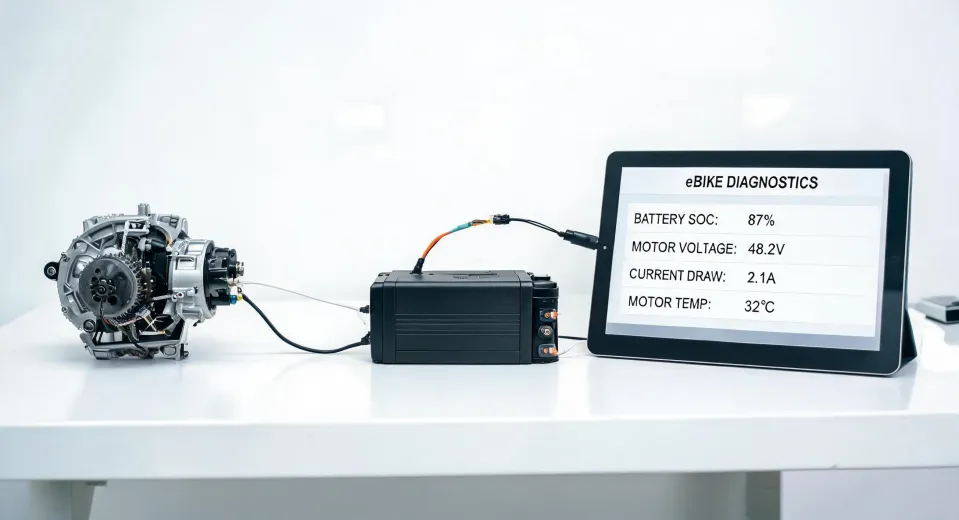
An e-bike motor is not a component. It is a system: drive unit, controller, display, battery interface, wiring harness, torque sensing and wheel speed sensing. If your company builds e-bikes, cargo bikes or light EVs, choosing a Bosch eBike drive system means adopting an ecosystem, not picking a motor from a spec sheet.
That is also why the Bosch vs Yamaha ebike motor conversation from consumer reviews is only partly useful to a business buyer. A consumer compares torque numbers and range estimates. A buyer has to compare repair turnaround, spare part availability and local support coverage. Yamaha builds excellent drive units. We standardized on Bosch because, in our region, the authorized service network and parts dispatch were faster—and when 60 cargo bikes share one drive unit model, service speed can outweigh a few newton-meters of peak torque.
New buyers also assume the motor and display ship as one set. With Bosch eBike systems, the drive unit, display and battery are separate part numbers. If you are quoting 100 kits, list each item individually. Missing one display model is not a small line item; it is a production stop.
The most overlooked spare part in our order history is the Bosch ebike speed sensor. It measures rear wheel speed and feeds that signal to the drive unit so assistance matches actual riding speed. The sensor is small but not universal—it must match the drive unit generation, and the magnet has to suit the wheel diameter and spoke arrangement.
That lesson became personal in March 2023. We moved a test bike to a smaller rear wheel, ordered a replacement speed sensor without confirming the motor generation, and paid for it with a two-week delay plus a restocking fee. Five minutes of verification at the quote stage would have prevented both. Now the speed sensor generation is a required field on our RFQ form.
Scenario 2: Motion Control Tasks—Servo Motors and the Feedback Question
When a machine has to index to a position, repeat a cycle or hold a torque target, the motor is usually an industrial servo with an encoder or resolver. In modern production equipment, true servo systems are typically three-phase brushless motors matched to a servo drive. So when I see a request for a 2 phase servo motor, I stop and make some calls.
Two-phase servo motors exist, but they occupy a narrow niche—historically, small instrument servos and simple control systems. In most factories, a request worded that way comes from an old manual, or from someone who actually needs a 2-phase stepper motor. At least, that has been my experience in our facility. Before ordering anything, check the existing servo drive and the nameplate: the drive expects a specific motor type, and phase count determines compatibility. If we skip that check, the result is a return, a waiting period and a line that stays down.
Feedback creates the second, more expensive mistake. Most buyers focus on motor power and completely miss the rotary torque sensor question—does the process really need to measure delivered shaft torque, or is the drive's internal current estimate enough? If product quality depends on torque at the spindle, which is true for fastening, pressing and test benches, a rotary torque sensor is the right call. If the application only needs position or speed control, a torque sensor is added cost and an extra mechanical failure point.
We added a rotary torque sensor to a gearbox test stand in 2024 so we could catch bearing problems before shipment instead of after installation. The sensor cost more than a standard encoder upgrade, but it pays for itself every time it rejects a defective unit early. That is prevention on a purchasing budget.
Scenario 3: Continuous Rotation—Spur Gears and Straightforward Reducers
Some drive requests do not need precise positioning or intelligent control. They need a shaft to keep turning at a practical speed, day after day. That is the mechanical transmission bucket, and it usually leads to the same question: which gear is most likely to use a spur gear?
Which gear is most likely to use a spur gear?
The gear arrangement most likely to use a spur gear is a simple reducer between two parallel shafts at moderate speed, where some gear noise is acceptable. Spur gears are straight-cut, efficient, inexpensive and generate no axial thrust, which keeps bearings simple. If the application is high-speed or noise-sensitive, you are more likely to see helical gears, whose angled teeth engage more smoothly. If the shafts intersect, you are in bevel or worm gear territory. For straightforward parallel-shaft speed reduction, the spur gear is usually the answer.
For purchasing, replacing a spur gear should be routine: module, number of teeth, pressure angle, bore diameter and face width. Those five numbers define the part. But orders arrive without them surprisingly often. A supplier cannot measure those details from a photo of a motor box, and every guessing round adds lead time. That delay is exactly what a few verification minutes at the start avoids.
How to Sort Your Own Order Into the Right Scenario
The framework only helps if you know which bucket you are in. Ask three questions, in order:
- Does the output drive wheels, pedals or a rider? If yes, it is an e-bike drive system decision—Bosch eBike or equivalent—and the speed sensor and torque sensor should be specified as part of the kit.
- Does the motion repeat to a position, speed or torque tolerance? If yes, it is a servo system decision. Confirm motor phase, feedback type, and whether the process actually needs measured torque from a rotary torque sensor.
- Does the shaft simply need continuous rotation through a gearbox? If yes, concentrate on reducer class and gear geometry—module, tooth count, pressure angle—rather than motion-control options.
Most hybrid-looking requests are really one of these three with unclear wording. A motor that “handles torque” usually belongs in scenario three until someone mentions positioning. A bike-related request is usually scenario one unless it is actually a test rig. There is no universal best drive. There is only the right answer for the application, and the five minutes we spend classifying an order at the start consistently saves the five days of correction we would otherwise spend on the wrong part at the end.
If you are a buyer without an engineering background, steal the habit that runs our purchasing office: classify first, compare brands second, verify sensors and interfaces third. It works for Bosch eBike systems, servo motors, rotary torque sensors and spur gear orders alike.