Cheap Motors Cost Us $5,000. Now I Calculate TCO Before Every Order
· Elena Markovic
Danny's Spreadsheet Changed How I Buy
In March 2025, Danny—our maintenance supervisor at a 200-person manufacturing company—flagged me down in the break room with a printed spreadsheet. Three line items were circled in blue ink: six e-bikes for the facilities crew, three stepper motor drivers for the conveyor line, and a dozen classic V-belts for the workshop. He tapped the e-bike line twice. "These were supposed to be in last year's budget. They're not going to wait another year."
I'm the office administrator, which also makes me the buyer. I manage about $60,000 in annual ordering across 14 vendors. I took over purchasing in 2021, and in 2024 I consolidated our vendor list from 22 to 14 by bundling orders. I'm not new to this. But everything I thought I knew about comparing prices got rewritten between March and August of last year.
All three orders looked routine. That's the embarrassing part. They were the most standard purchases on my calendar.
"Find the Best E-Bike with a Bosch Motor"
Our facilities crew covers about four acres of campus with gas golf carts that were dying one by one. One leaked oil, another couldn't make the hill past Building C. Management approved e-bikes—cheaper to run, easier to park, quieter. The engineering manager's request said: "Find the best e-bike with a Bosch motor."
I got three quotes. The first, from a national dealer: $2,800 per unit for e-bikes with a Bosch Performance Line motor (prices as of March 2025). Per the Bosch eBike Systems spec page (bosch-ebike.com), that motor is rated at 75 Nm torque. Six units: $16,800. The second, from an online distributor: $1,400 per unit with "equivalent specs"—750W motor, same battery range, same top speed. Six units: $8,400. The third vendor couldn't commit to delivery dates, so they were out.
Here's where the spreadsheet and my gut disagreed. The numbers said $8,400 in savings on a $60,000 budget. That is not nothing. My gut said: this distributor had no phone number, the product photos looked rendered, and the spec sheet had a typo in the voltage rating.
I went with the numbers. I ordered two cheap e-bikes as a pilot, telling Danny, "If they work for a month, I'll order the other four."
In hindsight, that's the one decision I'm grateful for. If I'd ordered all six, we'd have had six time bombs instead of two.
The Same Mistake, Two More Times
Same week, I ordered the stepper motor drivers. I found an $85 driver with specs identical to the $210 one Danny's team had been using: same voltage range, same current rating, same step resolution.
I assumed "same specifications" meant identical performance across vendors. Didn't verify. Didn't call the manufacturer. Didn't ask about duty cycle or how torque holds up under load. Ordered three.
And I ordered the V-belts. Twelve classic B-section belts, 48-inch outside length, from a marketplace reseller with decent reviews. $96, versus $132 from the industrial supplier down the street. Saved $36. Felt good about it.
Per FTC guidelines (ftc.gov), advertising claims have to be truthful and substantiated. None of the vendors were lying, technically. The problem is that spec sheets don't tell you what a part is like to run at 9 AM on a Tuesday, five days a week, under load. There's no row for "what breaks after 90 days."
Month Two: Everything at Once
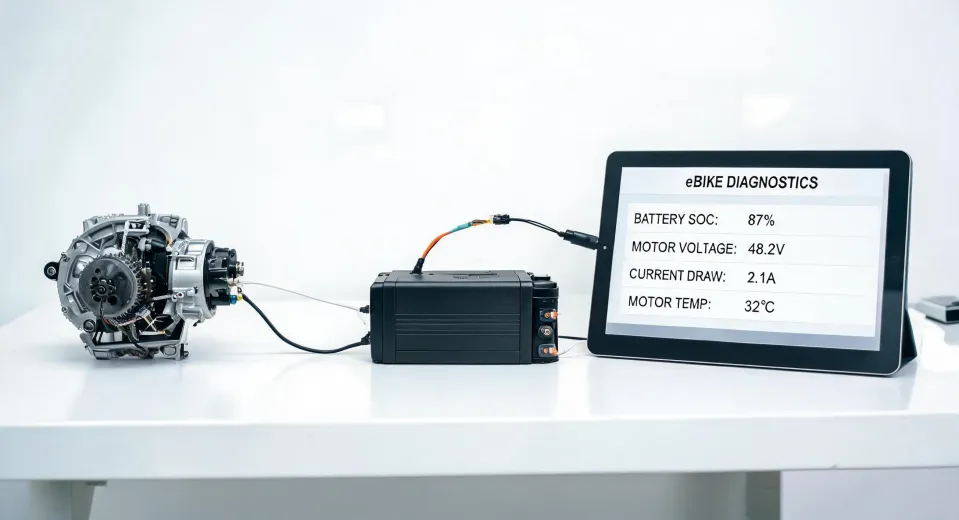
The pilot e-bike died on a Tuesday. No warning, no error code. It stopped mid-path between Building A and Building B, and Danny had to walk across campus with the other e-bike to go get it.
Service quote: $380 for a new controller, $150 labor, two weeks for parts because the vendor had no US stock. No local repair network. No USPS tracking number that worked. Just a ticket number and a promise.
The conveyor line started jamming the same week. Danny's email subject line: "stepper motor issues." The motors were missing steps. The line would stop mid-cycle, operators would reset it, and an hour later it would jam again.
I must have typed "how fast can a stepper motor turn" into a search bar three times, convinced the answer was the key. Here's the real answer: a stepper motor can spin at 2,000-3,000 RPM with nothing attached to it. Under load, torque drops off fast—usually past 500-1,000 RPM, depending on the driver and motor winding.
The motors weren't the problem. The driver was. The cheap driver couldn't sustain phase current at the speeds Danny's machines actually ran. It wasn't a speed question at all. It was a quality question, and I'd answered it by picking the driver that was $125 cheaper.
One of the three drivers burned out completely before the end of summer. It smoked. Danny held up the board with a pair of pliers and said, very calmly: "You want to keep saving money, or should we fix this?"
The V-belts stretched and glazed within six weeks. They lost grip under load, and Danny's team was retensioning them twice a week. A $36 savings generated about $200 in extra labor. Worse than worthless.
The Numbers Nobody Quotes
By August, I pulled the original POs and did the math the way I should have in March. Not as budget lines. As total cost of ownership.
E-bikes: six Bosch units upfront would have run $16,800. What we actually spent: two cheap units at $2,800, $530 in controller repair, $420 in motor work on the second unit, two replacement Bosch units at $5,600, then the remaining four at $11,200. Total: $20,550. The "cheap" route cost us $3,750 extra—and we still ended up with Bosch motors on every bike.
Stepper drivers: three quality drivers at $210 each would have been $630. We spent $255 on the cheap ones, $85 on a burnt-out replacement, and about $1,260 in production downtime—14 hours of jams at roughly $90 per hour loaded. Total: $1,600. Extra: $970.
V-belts: $96 for the marketplace deal, then $132 for the real ones, then about $200 in retensioning labor. Total: $428, versus $132. Extra: $296. And none of the original belts survived.
Total price of being cheap: about $5,000.
What I Do Now: TCO Before Any PO
I don't buy anything over $500 without a TCO check. Here's the framework:
- Failure cost. When this part stops working, does it inconvenience someone or stop production?
- Parts access. Can I get parts within 48 hours, or am I waiting two weeks for an overseas shipment?
- Service network. Is there anyone within driving distance who can actually diagnose and repair it?
- Downtime value. What is one hour of our line worth? For us, it was about $90 loaded. I learned that from production, not from a vendor.
- Real lifespan. Not the marketing lifespan—the lifespan a vendor will put in writing with a warranty.
Unit price is the price of admission. Total cost of ownership is the price of actually using the thing.
The Bosch e-bikes have run through fall and winter with zero issues. The new drivers hum at full torque. The new belts haven't been touched since installation day.
If you've ever picked the lowest quote because the spreadsheet made it look smart, you know where this is going. The spreadsheet is only as smart as the numbers you put in it. I left out the important ones: repair cost, downtime cost, replacement cost, my time, Danny's frustration. None of those show up on an invoice, so I ignored them.
That was a $5,000 mistake. I still look at unit price—you have to. But now it sits at the bottom of the page, not the top. That's where it belongs.