Your multimeter is lying to you (and other VFD mistakes I learned the hard way)
· Elena Markovic
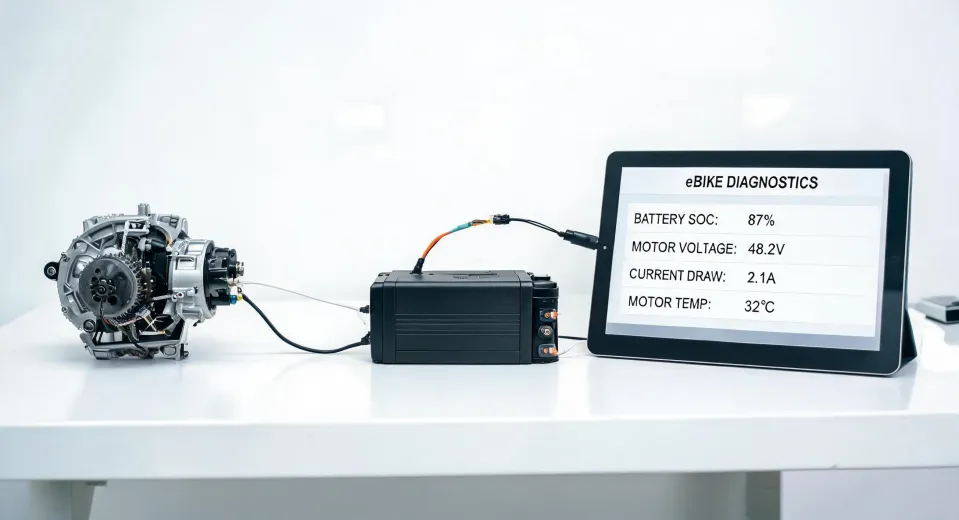
Three mistakes, one truth: Your test equipment is not infallible
I've been handling drive system service orders for seven years—mostly for e-bike dealers and light-industrial integrators. I've personally made (and documented) 31 significant mistakes, totaling roughly $14,200 in wasted budget. Now I maintain our team's diagnostic checklist to prevent others from repeating my errors.
The question I get most often isn't about Bosch e-bike motor specs or what VFD stands for (Variable Frequency Drive, though I suspect you already know that). It's this: "Why did my test say one thing, but the system did another?"
Spoiler: there is no single answer. It depends on what you're testing, with what tool, and—critically—how you interpret the result. Here are three scenarios I've lived through. Each taught me a different version of the same lesson.
Scenario A: The multimeter that lied about a drive unit's resistance
The setup
September 2022. A dealer called about a Bosch eBike motor (Performance Line CX) that had intermittent power loss. No error codes on the diagnostic tool. They asked me to check the motor phase winding resistance. Standard procedure: disconnect the motor cable, probe between U-V, V-W, W-U.
I measured the resistance on my Fluke 87V. All three pairs read 0.8 ohms. Textbook says 0.8–1.2 ohms is acceptable. I called it good. The dealer reinstalled the motor, and the bike still had power loss.
The next day, we swapped the drive unit under warranty—$950 cost. When I bench-tested the removed unit with a micro-ohmmeter, the actual resistance was 1.8 ohms on one pair. My Fluke simply couldn't resolve fractions of an ohm accurately enough in that range.
The lesson: A general-purpose DMM is not a precision low-resistance meter. For motor windings, you need a micro-ohmmeter or a four-wire Kelvin measurement. I documented that mistake as item #14 in my log: "Trusted DMM for sub-ohm measurement. Cost: $950 + 1-week downtime for dealer."
(I should mention: the diagnostic tool didn't catch it either—those tools check for shorts, not marginal resistance increases above spec.)
Scenario B: The VFD that wasn't really a VFD problem
The setup
Earlier this year, January 2025. A client had a conveyor drive with a VFD—an ABB ACS355—tripping on overcurrent with a "motor short circuit" fault. They'd replaced the motor, checked the cable, even swapped the VFD itself. The error persisted. They asked me to look at the line-side power quality.
I brought in a fluke power quality analyzer, expecting to find harmonic issues or voltage sags. Instead, I found something mundane: the EMC filter in the VFD's input section was partially dislodged—probably from a vibration during transport. It wasn't a motor fault at all. The drive's own internal diagnostics had misled everyone for two days.
The repair: reseat the EMC filter board and tighten the mounting screws. Fifteen minutes, zero cost. But before that, they'd spent approximately $2,000 on two unnecessary motor replacements and labor.
What most people don't realize is that VFDs generate fault codes based on algorithms, not direct measurement. A 'motor short circuit' can mean the drive detected anything that looks like a short—including a degraded gate drive board or, as we found, an internal loose connection.
(Oh, and I should add: we never did find the root cause of that EMC filter dislodging—could have been a rough ride from the distributor.)
Scenario C: The timing belt cover that was never the problem
The setup
A smaller mistake, but it stung. In my first year (2017), I ordered a custom timing belt cover for a linear actuator system. The specs called for a top gear motor mount with an integrated cover. I specified the cover material, thickness, and screw holes. Everything looked correct on the drawing.
When the part arrived—270 units, $3,200—every single one had the issue: the clearance between the cover and the belt was 0.5 mm. It looked fine on my screen, but in reality, the belt would rub against the cover at high speed. The result came back: scrapped. $3,200, straight to the trash. That's when I learned about thermal expansion. The belt and cover materials had different coefficients, and the clearance I'd specified was only adequate at room temperature—not at operating temperature.
I knew I should account for thermal effects, but thought, 'what are the odds it matters for a plastic cover?' Well, the odds caught up with me when thermal expansion reduced that 0.5 mm to zero. That error cost $3,200 plus a 3-week production delay.
How to tell which scenario you're in
There's no one-size-fits-all diagnostic rule. But here's a practical decision guide based on what I've learned:
- If your multimeter reads 0.00V or 0.00 ohms, but the system acts like there's a connection: You're probably in Scenario A. Get a better meter, or measure with known-good test leads and do a comparison test.
- If your VFD throws an error code that doesn't make sense after the motor and cable test fine: Suspect a non-motor issue—internal power supply, loose connector, or even a firmware glitch. Check the drive's own power rails before condemning the motor.
- If a mechanical assembly like a timing belt cover has tight clearance: Always factor in thermal expansion, vibration, and production tolerances. If you're guessing, allow at least 1.5 mm—or better, consult the motor and belt manufacturer's spec.
The common thread? Know the limits of your test equipment and your own expertise. The vendor who said 'this isn't our strength—here's who does it better' earned my trust for everything else. The tool that reported a perfect 0.8 ohms was wrong. The diagnostic algorithm that flagged a motor fault was misleading. And my own confidence in a quick calculation cost $3,200.
I'd rather work with a specialist who knows their limits than a generalist who overpromises. That applies to technicians, vendors, and—frankly—to myself every time I pick up a multimeter.