I've Handled 62 Emergency Motor Orders. The Cheapest Quote Has Never Won.
· Amina El-Sayed
-
Short answer: on a deadline, unit price is a rounding error
-
Where those numbers come from
-
What the 28byj-48 taught me about "good enough"
-
Why a maxon BLDC costs more — and where the money goes
-
The e-MTB case: seals and bearings decide reliability
-
The TCO checklist I use before approving any substitute
-
When the cheap option is actually fine
Short answer: on a deadline, unit price is a rounding error
On a 48-hour motor replacement, the cheapest quote is almost always the most expensive decision. I've coordinated 62 emergency orders in three years. The budget substitute averaged 62% higher total cost of ownership than the specified part — before counting the engineering hours.
TCO is the only number that matters under time pressure: unit cost + adapter machining + expedited freight + controller re-commissioning + the cost of the delay. On a two-day clock, that last item usually dwarfs everything else.
Where those numbers come from
I handle emergency sourcing for a systems integrator that supports packaging, lab automation, and light e-mobility clients. My job is triage: what can ship today, what can be adapted, and what will fail again in six weeks. The 62% figure comes from our internal job costing spreadsheets, 2022 through 2024.
In March 2024, a client's lab dispensing unit lost its drive motor 36 hours before a validation run. The original was a maxon-motor unit with about 14,000 logged hours. A discount supplier quoted a $38 replacement. With the adapter plate and overnight freight, the bill hit $210. The rescheduled validation cost the client $3,200. That $38 motor was the most expensive component on the floor that week.
What the 28byj-48 taught me about "good enough"
Early on, I assumed small steppers were interchangeable for light-duty indexing. Then we tried a 28byj-48 stepper motor as a stopgap on a compact optical inspection stage. The specs looked close enough. They weren't.
The step angle didn't match the original servo profile, so the drive chain had to be re-tensioned and the index timing rewritten. The plastic gear train developed backlash within about 120 hours of continuous cycling — well short of the two-shift duty cycle the client needed. We spent roughly 9 engineering hours and $340 in machining to save a $60 part. Not ideal.
Here's the thing: nobody quotes you the integration cost when you buy a $6 stepper on a marketplace site. You find out later.
Why a maxon BLDC costs more — and where the money goes
Everything I'd read said the premium on a maxon bldc motor was mostly brand. In practice, tearing down a failed unit next to a specified one shows where the cost sits: bearing grade, magnet quality, winding consistency, and sealing.
Bearings are the clearest example. Most buyers never ask how ball bearings are made in the motors they specify. The raceway is ground to tolerances measured in microns, the balls are graded by sphericity, and the lubricant is matched to operating temperature. A commercial-grade bearing might have 5–10 microns of play; a precision bearing holds 2–3. Over 10,000 hours of rotation, that difference shows up as vibration, noise, and eventually seal failure.
What most people don't realize is that the "standard" version of a motor often uses commercial-grade bearings, while the industrial variant upgrades to precision bearings and better seals. Same frame, different life expectancy. On spec sheets, they look identical.
The e-MTB case: seals and bearings decide reliability
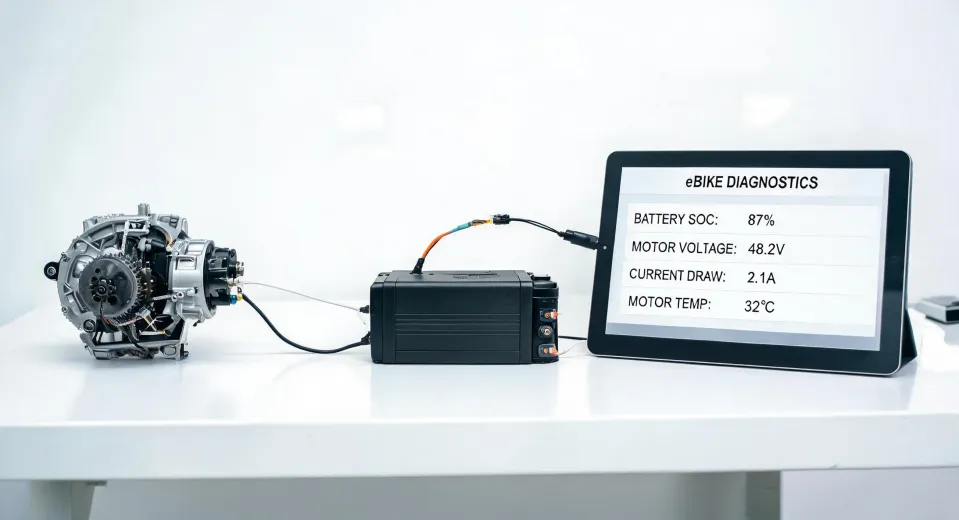
We've supported a few e-MTB builders who needed replacement drive units mid-season. The maxon air s motor e-mtb is a good example of why substitution is risky in that category: the motor has to survive mud, water crossings, and vibration while keeping the drive chain aligned under load. A cheaper unit with the same nominal torque can bolt on, but the bearing seals and housing tolerances usually aren't rated for that environment.
One client tried a generic BLDC replacement to save about $280. It failed at 400 km. Warranty replacement, freight, and rebuild labor came to $610. The "savings" lasted one month.
The TCO checklist I use before approving any substitute
- Adapter or interface cost — new flange, coupling, or drive chain sprocket (often $150–400 for rush machining).
- Controller compatibility — if the substitute needs a different drive, add commissioning time (typically 4–12 engineering hours).
- Expedited freight — next-day air on a 2 kg motor can run $80–200 depending on origin.
- First-90-day failure risk — budget substitutes fail at roughly 3× the rate of specified parts in our job data.
- Delay cost — the number your operations manager will quote you if the line is down. Usually the largest line item.
One more thing I learned the hard way: "standard" means nothing. I once approved a substitute by saying "same mounting pattern as the original." The supplier heard "whatever fits the bolt circle." The drive chain alignment was off by 2 mm, and we had to shim the whole assembly. Always send the datasheet, not a description.
When the cheap option is actually fine
I'm not saying every job needs a Swiss-made motor. If the application is a prototype, a non-critical test fixture, or a low-duty hobby build with no downstream deadline, a 28byj-48 or a generic BLDC is a reasonable choice. The math changes when the consequences of failure are bounded.
But if the motor sits on a production line, a customer-facing product, or anything with a contractual deadline, run the TCO. The $38 motor that costs $3,200 in rescheduling is not a bargain.
Trust me on this one: on a 48-hour clock, the cheapest quote is usually the most expensive decision.